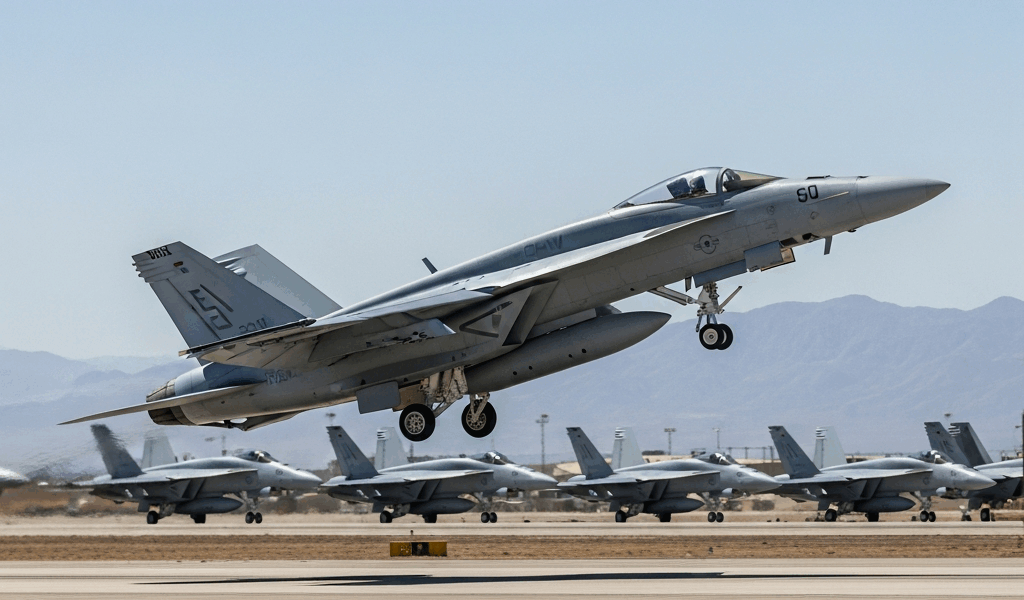
Is Top Gun a Real School? What TOPGUN Actually Is
Top Gun has gotten complicated with all the Hollywood mythology flying around. As someone who’s spent years obsessing over naval aviation history, I learned everything there is to know about the gap between what people think TOPGUN is and what it actually does — and that gap has always bothered me in the best possible way. The school exists. The call signs exist. The brutal competition for a spot exists. What doesn’t exist: the volleyball, the personal grudges settled through aerial combat, the idea that getting assigned there means you’re already the best. The real program is more rigorous, more institutional, and frankly more impressive than anything Hollywood had the budget to explain.
Yes, TOPGUN Is Real — But Not Like the Movie
The formal name when it launched was the Navy Fighter Weapons School. Most people still call it TOPGUN, and the Navy doesn’t exactly fight that branding. Founded in March 1969 at Naval Air Station Miramar in San Diego — timing that matters, because it came directly out of a performance crisis over the skies of Vietnam.
Here’s the problem the Navy had. In Korea, the kill ratio against enemy aircraft sat around 13:1. By Vietnam, that number had collapsed to roughly 2.5:1. Pilots were getting beaten in close-range maneuvering fights, and nobody could explain why — until the Ault Report landed on someone’s desk in 1968. Captain Frank Ault led the study. His conclusion was blunt: your pilots are trained to fire missiles from beyond visual range and have almost zero training in old-school dogfighting. The enemy knew it and exploited it.
TOPGUN was the direct answer. Gather the best instructor pilots, teach them adversary tactics — specifically Soviet-style tactics used by North Vietnamese pilots — then push fleet aviators through realistic air combat maneuvering. The concept worked. By the war’s end, the kill ratio had climbed back significantly, and TOPGUN got most of the credit. Probably deserved it.
Today the school operates under a larger umbrella. In 1996, TOPGUN moved from Miramar to Naval Air Station Fallon in Nevada and was absorbed into the Naval Aviation Warfighting Development Center — NAWDC, if you want the acronym. NAS Fallon delivers something Miramar never could: enormous restricted airspace over the Nevada desert, room to run large, complicated multi-aircraft engagements that simply aren’t possible above suburban San Diego. TOPGUN sits alongside similar programs for strike warfare, electronic attack, and maritime patrol aviation. The core mission hasn’t changed — produce tactical experts and push the ceiling of what naval aviation can do in an actual fight.
How Pilots Get Selected for TOPGUN
Probably should have opened with this section, honestly, because it’s where most of the mythology falls apart completely.
You cannot apply to TOPGUN. There is no application. You don’t raise your hand. Your squadron nominates you — and even getting nominated means you’ve already proven yourself at a level most pilots never reach.
The selection criteria are specific. A pilot nominated for the Strike Fighter Tactics Instructor program — the formal name for what people call the TOPGUN course — typically needs at least one fleet deployment under their belt, significant hours in type, and a commanding officer willing to vouch that they can not only survive the training but return and actually teach what they learned. That last part is critical. TOPGUN doesn’t exist to make one pilot marginally better. It exists to make that pilot a multiplier — someone who goes back and elevates an entire squadron.
Students showing up at Fallon are not rookies. They’re flying F/A-18C/D Hornets, F/A-18E/F Super Hornets, or EA-18G Growlers — experienced fleet aviators with hundreds or thousands of hours already logged. And they’re still going to spend the first week getting intellectually humiliated in academic briefs before they ever strap into a jet. Don’t make my mistake of thinking the movie selection process — best of the best, competitive ranking, individual glory — maps onto anything real.
Nominations typically pair one officer with one naval flight officer per squadron cycle, though exact numbers shift based on class size and community needs. Being passed over when you thought you were ready is its own particular gut punch — one that several aviators I’ve read about described as a hard recalibration of their self-assessment. Apparently that feeling doesn’t go away quickly.
What the Training Actually Involves
The course runs approximately 12 weeks. No extended beach montages. Lots of early mornings, long briefs, and debrief sessions that can run two or three hours after a single 45-minute flight. That ratio — more time talking about the flight than actually flying it — surprises most people.
The structure splits between academic and flight portions, and both are serious. The academic side covers threat systems in depth: Soviet-designed aircraft, modern adversary tactics, radar and missile employment, electronic warfare. Students walk out of those briefs knowing how an adversary pilot thinks, what his jet can do at various energy states, where his vulnerabilities are. This isn’t trivia — it feeds directly into how they fly.
The flight portion builds around air combat maneuvering — ACM — progressing in complexity. Early sorties might be one-versus-one basic fighter maneuvers, the debrief afterward a surgical dissection of every decision made and why it was wrong. Later scenarios grow into multi-bogey engagements with electronic warfare layered in. TOPGUN instructors fly the adversary role aggressively, replicating actual threat aircraft. Students lose. Frequently. That’s the point — learning why is the whole exercise.
Weapons employment gets serious attention too. Not just the AIM-9X Sidewinder in close — the longer-range AIM-120 AMRAAM, understanding its kinematic envelope, knowing when to shoot versus when to maneuver. The course also integrates with larger strike warfare training at Fallon, so students see how fighter cover fits into a full strike package with electronic attack, tanker support, and surface coordination.
There is no volleyball tournament. That probably needs to be said plainly.
TOPGUN Graduates — Where They Go After
But what is an SFTI graduate, really? In essence, it’s a fleet aviator who completed the Strike Fighter Tactics Instructor course. But it’s much more than that — the expectation is immediate, concrete, and heavy.
You go back to your fleet squadron as the resident tactical expert. You run the training program. You conduct academic briefs on a Wednesday afternoon in a conference room that smells like bad coffee. You mentor junior pilots who are asking the same questions you were asking three years ago. That’s what makes TOPGUN endearing to us aviation enthusiasts — it’s fundamentally a teaching machine disguised as an elite fighter school.
Fascinated by how much institutional leverage the Navy extracts from a single training pipeline, I tracked down accounts from several SFTI graduates. Consistent theme across all of them: the debrief discipline installed at Fallon changed how they approached every flight afterward. Not just combat missions — everything. The habit of asking “what decision did I make and was it the right one” is apparently hard to turn off once it’s built in.
Some graduates return to Fallon as instructors — a separate, additional qualification. You don’t automatically become an instructor by completing the course. Instructor billets are limited, competitive, and draw from graduates who demonstrated exceptional ability during training and kept building their tactical reputation afterward. Being a TOPGUN instructor might be the best career marker available in naval aviation, as the community is small enough that everyone knows everyone and reputation travels fast. That is because the fighter community is tight-knit in ways that outsiders underestimate.
Career-wise, the SFTI qualification shows up on fitness reports and matters during promotion board reviews. Graduates tend to land in commanding officer and executive officer billets at higher rates than non-graduates — though plenty of exceptional aviators never attended and still had outstanding careers. It’s an accelerant, not a guarantee.
How Accurate Were the Movies
Two films now. They made different choices and deserve different assessments — so let’s separate them.
Top Gun — 1986
Frustrated by the Navy’s image problem in the early 1980s, the Defense Department greenlit cooperation with Tony Scott’s production using Miramar’s actual facilities and real F-14 Tomcats on loan from active squadrons. The physical setting was accurate — that’s where TOPGUN operated at the time. The Tomcat was legitimately one of the most capable fighters of that era. The basic concept of elite school, elite pilots, elite competition — directionally correct.
What it mangled: individual competitive rankings don’t work that way in reality, personal vendettas driving tactical decisions would end a career in the actual Navy, and the idea that a graduate immediately deploys into the exact crisis they trained for is pure Hollywood convenience. The real program is institutional. Maverick’s arc works as a movie arc — and as a representation of how the culture functions, it’s misleading in ways that stuck around for decades.
Also — the MiG-28 doesn’t exist. The film used F-5E Tiger IIs painted black, relabeled for production. Real adversary aircraft at Fallon have included actual surplus Soviet-designed jets acquired through various programs over the years. That’s its own fascinating rabbit hole, honestly.
Top Gun: Maverick — 2022
The sequel is significantly more accurate in technical detail — you can feel the Navy’s deeper involvement throughout. The Super Hornets look and sound right. Mission planning sequences reflect something closer to how actual strike packages get built. The tension between Maverick’s instinct-driven style and the institutional Navy mirrors a genuine ongoing argument in aviation culture: trusting data versus trusting feel. That tension is real. It shows up in flight safety discussions, in debrief rooms, in arguments between experienced pilots who disagree about what the numbers are actually telling them.
The F-14 sequence at the end was fan service — everyone knew it walking in. The Tomcat retired in 2006. No operational F-14s remain in U.S. Navy inventory. Iran still flies a small number of theirs, which made the enemy nation’s identity pointedly ambiguous in terms of geography and aircraft. Deliberate production decision, not an oversight.
This new idea — that TOPGUN is a school rather than a tournament — took off in Maverick and eventually evolved into the more honest portrayal enthusiasts know and appreciate today. Students in the film are learning a specific mission profile, not competing for a trophy. That’s closer to reality. The final act still belongs to Hollywood physics, but the setup earns more credibility than the 1986 version ever attempted.
The real TOPGUN — NAWDC’s Strike Fighter Tactics Instructor program at NAS Fallon — has been shaping American naval aviation for over 50 years. It came out of a genuine crisis, solved a measurable problem, and keeps evolving as the threat environment shifts. It doesn’t need a movie’s drama to be worth understanding. It already is.


Leave a Reply