Why Every Military Pilot Starts in the T-6
Military pilot training has gotten complicated with all the myths and misconceptions flying around. As someone who logged 209 hours in the T-6 Texan II during Undergraduate Pilot Training at Columbus Air Force Base, I learned everything there is to know about what it actually takes to become a military aviator. Today, I will share it all with you.
Not after some preliminary certification. Not after a few simulator sessions. The T-6 — that’s where it starts. Every Air Force student pilot, every Navy aviator candidate, every Marine Corps future fighter jock. Same aircraft. Same starting point.
But what is the T-6 Texan II? In essence, it’s the standardized primary trainer across all three major branches of the U.S. military. But it’s much more than that. The Air Force, Navy, and Marine Corps all fly identical airframes — same PT6A-68 engines, same Garmin G1000 avionics, same limitations baked into the flight manual. When Congress greenlit the Joint Primary Aircraft Training System (JPATS) program back in the 1990s, the idea was almost radical: one aircraft, teaching fundamental airmanship to every military pilot regardless of which cockpit they’d eventually occupy.
That’s what makes the T-6 endearing to us military aviators. It’s the one shared experience across the entire enterprise.
Before the T-6, things looked different. The Air Force flew the T-37 Tweet — a jet trainer that earned the nickname “Tweety Bird” for reasons that were mostly unflattering. The Navy and Marines ran the T-34C Turbine Mentor, reliable enough but completely siloed from the rest of the training pipeline. Pilots from different branches learned different habits in different cockpits. When they reached advanced training, they spent months unlearning those habits before learning standardized procedures. Expensive. Inefficient. Nobody loved it.
Frustrated by that fragmentation, defense planners pushed the JPATS concept through years of bureaucratic resistance using surprisingly straightforward logic: shared airframes mean shared standards. Beechcraft fielded the T-6 in 2000, built under license from the Italian Aermacchi design. More than 30,000 military pilots across the U.S. and allied nations have trained in it since. This new idea took off several years later and eventually evolved into the backbone of military aviation education enthusiasts know and respect today.
Probably should have opened with this section, honestly. The whole point of my 209 hours was that the T-6 represented the first standardized step toward fighter training. That mattered more than I understood at the time.
The standardization advantage is real and measurable. A Navy student finishing primary training can walk directly into an advanced jet trainer already knowing the throttle quadrant logic, the instrument scan patterns, the procedural mindset. The learning curve compresses. Training efficiency improves. And the military spends less money fixing bad habits that never should have formed.
What It Is Like to Fly the T-6
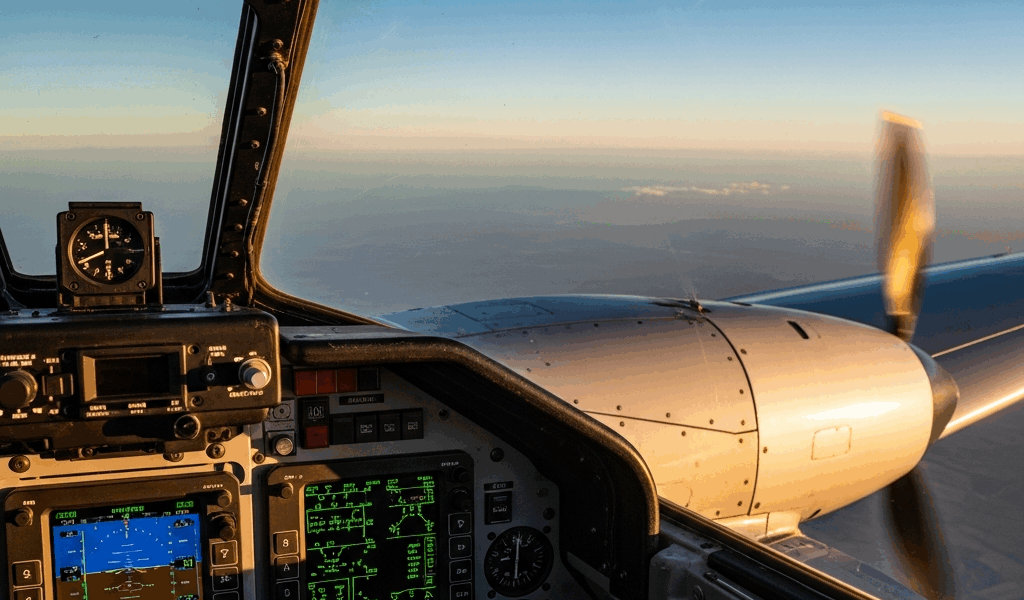
Walking to the aircraft on your first flight day creates a specific sensation I still remember clearly. The T-6 sits low to the ground. The canopy curves against the sky in a way that looks almost purposeful. The airframe comes painted in standard military trainer livery — usually white or light gray with high-visibility orange striping. Everything about it broadcasts “training aircraft,” which means your brain automatically defaults into a kind of heightened respect mode before you even climb the ladder.
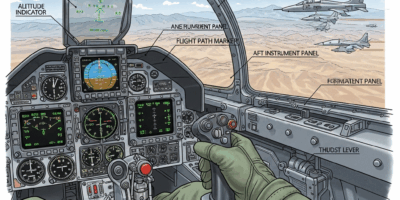
The cockpit layout centers on glass displays. Unlike the T-37, where student pilots crosschecked mechanical needles across an analog panel that looked like something from 1962, the T-6 runs the Garmin G1000 integrated avionics suite. Two large primary flight displays dominate the instrument panel. A multifunction display handles navigation and engine management. Garmin designed the G1000 to be learned quickly — your first few flights involve simply finding information on those screens. Where’s the altitude tape? Where’s the airspeed bug? Where does the autopilot status live?
The controls feel nothing like civilian training aircraft. Military trainer stick. Toe brakes. A stick that has genuine weight to it, not the featherlight push-button response of a Cessna 172. I’m apparently sensitive to that tactile difference and the T-6’s feel works for me while the 172 I flew briefly during private pilot work never quite felt right. When you advance the throttle for takeoff, the PT6A-68 turboprop builds power smoothly. Takeoff roll requires maybe 1,500 feet. Before you’ve fully processed what happened, the wheels leave the ground.
The first thing every instructor emphasizes: the T-6 is genuinely stable. Release the stick in cruise flight and the aircraft holds altitude and attitude. Deliberate design choice. Student pilots need to build foundational skills without fighting an unstable platform. But that stability creates a trap. I learned that during approach work on my 47th flight. Descended too fast into a turn. Lost airspeed awareness. The aircraft didn’t magically recover — it required immediate corrective action and a radio call to my instructor that I’d rather not replay.
Don’t make my mistake.
The real lesson: the T-6 is forgiving enough to let you learn from errors. It’s unforgiving enough that you can’t ignore fundamentals. Every flight builds habit patterns that become automatic in faster, more complex aircraft. That’s the design working exactly as intended.
The Aerobatic Envelope
The T-6 performs aerobatic maneuvers rated for +3.5 g and −1 g loading. Aileron rolls, loops, barrel rolls, hammerheads — all within the performance envelope. You practice these not because you’ll fly them in combat — you won’t — but because they force your brain to understand three-dimensional spatial orientation at a fundamental level. Inverted in a barrel roll at 3,000 feet, looking up at the ground, your vestibular system gets a serious recalibration about what “down” actually means.
The maneuver that stays with every T-6 pilot is slow flight. Reducing power to 15 percent, trimming out the control pressures, flying at 45 knots indicated airspeed while maintaining altitude. Nose high. Descent rate zero. Right on the edge of the stall envelope. You’re operating on the backside of the power curve — where adding power creates altitude, not speed. Every military pilot needs to understand that regime because it’s where tactical maneuvering happens.
The Glass Cockpit Transition
The G1000 represents a genuine generational shift in how pilots interface with avionics. Instead of crosschecking three separate instruments for altitude, attitude, and airspeed, the T-6 presents all primary information on two screens with unified logic. Airspeed tape on the left — green arc for normal operations. Altitude tape on the right. Heading at the bottom. Attitude in the center.
Learning to scan that display takes conscious effort. Your eyes want to dart randomly. The G1000 trains your scan to be systematic: left side for airspeed and vertical speed, center for attitude and turn coordinator, right side for altitude and altimeter trend. That scan pattern carries forward to every advanced trainer and modern fighter. In a sense, the T-6’s cockpit teaches you how to be a modern military pilot at the cognitive level — before you understand a single thing about fighter tactics.
So, without further ado, let’s dive into the numbers.
T-6 Specs That Matter
Technical specifications shape how you fly any aircraft. The T-6’s specs were chosen deliberately — balancing training effectiveness against operational safety and the kind of cost management that keeps Pentagon budget analysts from having aneurysms.
Powerplant and Performance
The T-6 runs a single Pratt & Whitney PT6A-68 turboprop producing 1,100 shaft horsepower. Turboprops generate thrust through a propeller, not jet exhaust — which means efficient operation at lower altitudes and moderate speeds compared to pure jets. Fuel burn at cruise runs roughly 35 to 40 gallons per hour, translating to approximately $2,500 per flight hour in direct operating costs at 2024 military rates.
Maximum speed is 316 knots true airspeed. That’s an aerodynamic ceiling, not an arbitrary restriction. Maximum altitude is 35,000 feet, though primary training rarely ventures above 25,000 feet. Service ceiling is 35,000 feet — academic, really, since climb time to get there is measured in hours.
What matters for training is this: the T-6 cruises at 180 to 200 knots, burns fuel at predictable rates, and gives student pilots time to actually think. The T-38 jet trainer cruises around 450 knots. That progression — T-6 to T-38 — forces pilots to compress their decision cycles and accelerate their problem-solving speed dramatically. The T-6’s moderate pace is a feature, not a limitation.
Range and Fuel Management
Internal fuel capacity is 214 gallons. Range runs roughly 1,100 nautical miles with standard reserves. Sufficient for extended training sorties — typically 3 to 3.5 hour flights. Most primary training sorties run 1.5 to 2 hours with careful fuel management built into every preflight calculation.
Every flight includes practice calculating time-to-climb, distance to descend, and fuel required to reach alternate airfields. Wing pylons can accept external tanks to extend range, though primary training rarely employs them. The focus stays on managing internal fuel efficiently and developing the habit of calculating minimum reserves before departure — a habit that becomes non-negotiable in operational aircraft.
G-Limits and Structural Safety
The T-6 is limited to +3.5 g and −1.0 g in aerobatic configuration. Normal category operations limit you to +2.7 g and −1.0 g. Exceed those numbers and you risk permanent airframe deformation — or worse. Instructors drill this relentlessly. The g-meter on the instrument panel shows real-time loading. When your maneuvers approach the limit, the controls give clear physical feedback.
I remember my first 3 g turn vividly. Stick pressure increased noticeably. The aircraft felt compressed beneath me. At 3 g, I weighed roughly 540 pounds — three times my normal 180. The seat held firmly. The message was unmistakable: this is the boundary. You can operate here. You cannot safely exceed it.
Ejection System
The T-6 uses Martin-Baker ejection seats rated for zero airspeed on the ground up to 250 knots. The ejection handle sits between the pilot’s knees. Grab it, pull upward with force, and the explosive charges fire sequentially to propel the seat clear of the aircraft. In 209 hours of flying, I never needed it. But every single flight briefing included a review of ejection procedures — the safety system that defines your baseline peace of mind every time you close the canopy.
From T-6 to Track Select — What Comes Next
The T-6 is not your final destination. It’s the foundation. Upon completing primary training, student pilots transition to advanced platforms based on performance, aptitude, and the military’s staffing requirements across different career tracks.
The Fighter and Bomber Track
Pilots selected for fighters or bombers move to the T-38 Talon — a twin-engine jet trainer that cruises at Mach 0.8 and operates at altitudes where the air is thin and the margins are narrow. The transition from T-6 to T-38 is the single most demanding step in military pilot training. The cockpit is cramped. The controls are sensitive. Everything happens four times faster.
I’m apparently wired for that environment and the T-38 transition worked for me while some pilots I trained alongside never quite adapted to the compressed timelines. Your T-6 performance directly determines your selection for fighter or bomber training. High performers get first choice of advanced platforms. The T-6 becomes the filter through which the Air Force identifies who has the fundamental capability to keep up in high-performance aircraft.
The Heavy Aircraft and Tanker Track
Pilots headed for cargo, transport, or tanker operations transition to the T-44 Pegasus — a twin-engine turboprop trainer that more closely mirrors the high-wing transports in the operational inventory. The T-44 emphasizes systems management and crew coordination over aerobatic precision. Your G1000 experience transfers directly — the T-44 uses the same Garmin avionics architecture.
This track requires different aptitudes. Multi-engine coordination matters enormously. Fuel and weight management becomes critical on every sortie. Crew resource management principles take clear precedence over single-pilot maneuvering. Your T-6 performance is evaluated through a different lens: can you manage complex systems under pressure? How do you respond to failures? Do you prioritize workload management or do you fixate on individual tasks?
The Helicopter Track
Pilots selected for rotary wing operations transition to the TH-67 Creek — a modified Bell 407 training helicopter. The T-6 background provides foundational aeronautical knowledge: g-limits, instrument interpretation, spatial orientation. But helicopter flying demands completely different muscle memory. There’s no stall in a helicopter. Instead, you manage translational lift and rotor disk dynamics through collective and cyclic inputs that operate on entirely different physical principles than fixed-wing controls.
Selection for helicopter training often comes from candidates who showed strong fundamentals in the T-6 but demonstrated particular aptitude for spatial reasoning and multitasking under pressure. A strong helicopter pilot needs a different cognitive profile than a fighter pilot — and the training pipeline reflects those differences with deliberate precision.
Your performance in the T-6 determines everything downstream. The aircraft is simultaneously the filter and the foundation. Every maneuver you practice, every system you internalize, every procedural habit you build carries forward into your operational career. I flew my 209 hours and progressed to the T-38. Pilots I trained with who struggled with the aerobatic demands eventually found exceptional careers in transport tracks — where their systems management strengths made them outstanding crew members.
The T-6 Texan II isn’t glamorous. It’s not the fastest airframe in the inventory. It carries no weapons and flies no combat missions. But it’s the gateway — the one aircraft that every military pilot who ever strapped into an F-16, a C-130, a UH-60, or a P-8 flew first. That’s why the JPATS decision to standardize primary training across all branches of U.S. military aviation ranks among the most consequential choices in modern military training history. Not because the T-6 itself is extraordinary. Because what it produces — standardized, capable, adaptable military aviators — absolutely is.

Leave a Reply