Air-to-Air Refueling and Why Every Military Pilot Learns It
Air-to-air refueling has gotten complicated with all the different systems and techniques flying around military aviation these days.
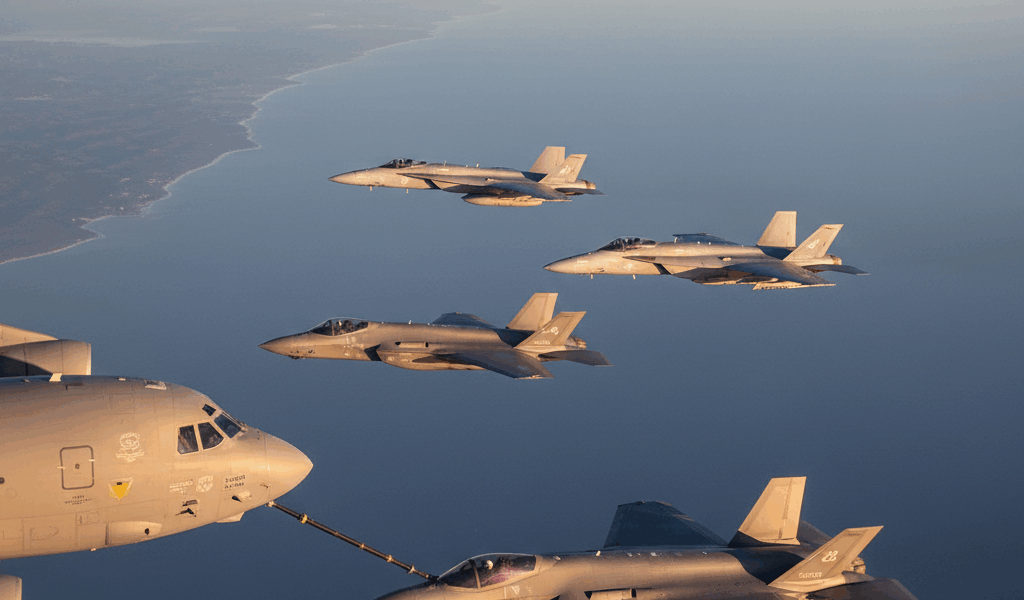
Air-to-air refueling extends military aircraft range beyond any practical limitation you might otherwise face. Mastering this demanding skill transforms tactical aircraft into strategic assets capable of projecting power across oceans and continents without landing. Every military pilot eventually learns to tank regardless of what they fly, though the difficulty varies dramatically between aircraft types and the conditions you’re operating in.

Two Methods, One Goal
Probably should have led with this section, honestly. The U.S. Air Force primarily uses the flying boom system that most people picture when they think of aerial refueling. A tanker operator extends a rigid boom toward the receiving aircraft, which maintains precise position in a small refueling envelope that leaves no room for error. The receiver pilot’s job is station-keeping while the boom operator makes the actual connection—you’re basically a platform for someone else to work with.
The probe-and-drogue system, preferred by the Navy and Marine Corps, requires the receiver pilot to fly a probe into a basket trailing behind the tanker on a flexible hose. This method demands more precise flying from the receiver pilot since you’re doing all the work, but offers more flexibility for tanker operations since multiple aircraft can tank simultaneously.
The Challenge of Formation Flying
That’s what makes refueling so demanding—it requires formation flying at its most precise level. Receiver aircraft maintain position within just a few feet of the tanker while traveling at hundreds of miles per hour through the sky. The slightest deviation breaks the connection and requires repositioning, which wastes time and fuel you might not have.
Turbulence makes the task even more demanding than it already is. Aircraft bounce and shift unpredictably in rough air, requiring constant control inputs to maintain the refueling position without disconnecting. Pilots describe challenging refueling sessions as among the most physically exhausting experiences in aviation—you’re gripping that stick hard and working every muscle.
Night and Weather Operations
Combat operations don’t pause for darkness or bad weather, and neither does the need for fuel. Military pilots train to refuel in conditions that would ground civilian aircraft without hesitation. Night refueling with limited lighting tests even experienced aviators who’ve done it dozens of times, while weather refueling adds instrument flying to an already saturated task list in the cockpit.

Director lights on the tanker help receivers maintain position in darkness, but the visual references differ dramatically from daylight operations in ways that take adjustment. Many pilots consider night refueling their most challenging regular task—it never gets routine no matter how many times you’ve done it.
Tanker Crews
The tanker community deserves recognition for enabling power projection that everyone else depends on. KC-135 and KC-46 crews fly long, monotonous missions to position themselves exactly where fighters need fuel when they need it. Their unheralded professionalism makes every combat operation possible, even if they never get the glory that fighter pilots receive.
Air-to-air refueling represents a uniquely military capability that fundamentally changes what airpower can accomplish around the world. The skill required to master it builds the precision flying habits that serve pilots throughout their careers no matter what platform they eventually fly.

Leave a Reply