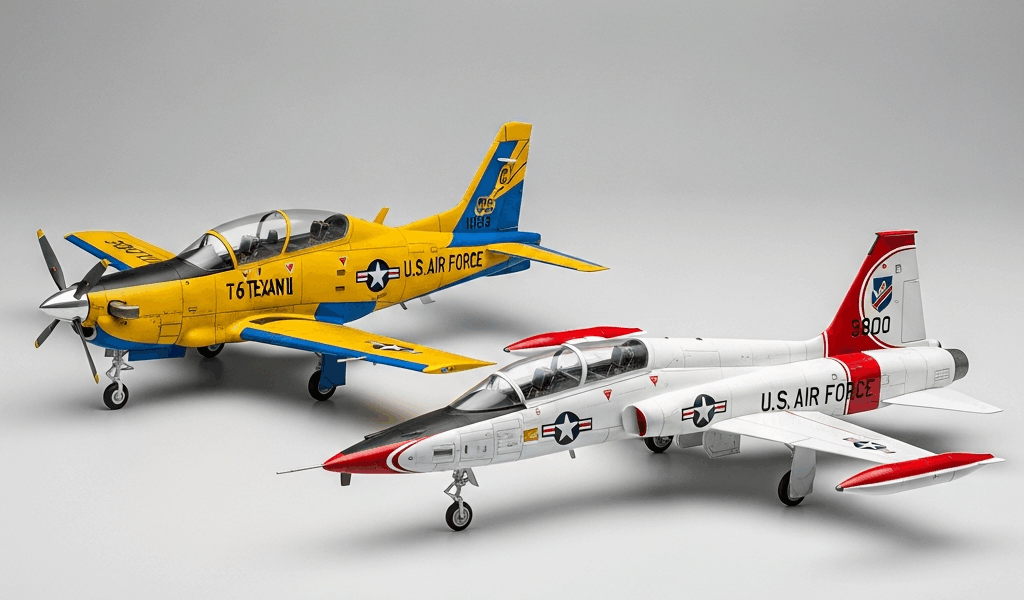
T-6 Texan II vs T-38 Talon — Pilot Training Aircraft
Military pilot training has gotten complicated with all the mythology flying around. And I’ll tell you right now: no AETC fact sheet explains what it feels like to climb out of a turboprop after 86.6 flight hours and strap into a twin-engine jet that punishes hesitation. That’s what this article is for.
The T-6 — Where Every Military Pilot Starts
But what is the T-6 Texan II? In essence, it’s a single-engine turboprop built by Raytheon — now Beechcraft Defense — powered by a Pratt & Whitney Canada PT6A-68 cranking out 1,100 shaft horsepower. But it’s much more than that. It replaced both the T-37 Tweet and the T-34C Mentor in the early 2000s and became the universal starting point for Air Force, Navy, and allied nation pilots alike. Max gross weight sits around 6,500 pounds. Two seats in tandem under a bubble canopy. Tops out near 316 knots indicated. Those numbers matter less than what you do with the airplane across roughly 86.6 syllabus hours.
The T-6 syllabus breaks into three phases — contact, instruments, and formation — each one teaching a genuinely different skill. Contact is stick and rudder fundamentals: steep turns, stalls, emergency procedures, pattern work. You will spin this airplane intentionally. That’s not a figure of speech. The syllabus requires full departure stalls and incipient spin entries — something commercial training barely touches. Instructors at Vance described watching students discover, sometimes violently, that rudder coordination is not optional in a propeller-driven aircraft producing that much torque.
Instruments phase is exactly what it sounds like — partial panel approaches, holding patterns, ILS procedures flown under a hood, checkride at the end. The T-6 cockpit runs a Garmin-sourced digital glass panel with a Collins Pro Line 21 avionics suite. So students are learning steam gauge crosscheck habits while simultaneously staring at a modern MFD. It creates an interesting tension, honestly. Formation phase comes last — and that’s where a lot of students find out whether they actually have the visual precision the Air Force wants.
What Track Select Actually Means
Probably should have opened with this section, honestly — because without understanding track select, the T-6 versus T-38 comparison doesn’t carry the weight it should.
Here’s what recruitment brochures skip entirely. At the end of T-6 training, a board reviews your grades, your commander’s assessment, your stated preferences, and the needs of the Air Force — in roughly that order — and assigns a follow-on track. Fighter/bomber track means T-38s. Airlift/tanker track means the C-130H-derived T-44 or straight to the C-17 FTU depending on year group. Helicopter track means the TH-1H Iroquois.
This single event determines the entire shape of your military flying career. Students averaging in the 90s on their gradesheets — the ones who show instinctive spatial awareness in formation — tend to land fighter/bomber. Solid but less aggressive performers go airlift/tanker. The decision isn’t always fair. Several instructors told me they’d watched technically proficient students lose fighter track because a standardization checkride happened on a bad weather day. That’s the reality. Don’t make my mistake of glossing over that detail early — it reframes everything that follows.
The T-38 — Supersonic and Unforgiving
The T-38C Talon is a 1959 design still flying in 2024. Let that sentence sit for a second. Frustrated by the performance limitations of slower jet trainers, Northrop built the original T-38A under a contract that dates back to the Eisenhower administration — using what were, at the time, cutting-edge J85 turbojet engines — and the Air Force has kept it alive ever since through incremental upgrades. The C-model gets a glass cockpit via the Avionics Upgrade Program, adding a wide-angle HUD and MFCD displays. But the bones are original. Twin General Electric J85-5 turbojets, each producing 2,900 pounds of thrust with afterburner, push it past Mach 1.08 in a shallow dive. At roughly 12,093 pounds max gross, it’s a completely different animal than the T-6.
The syllabus runs approximately 95.5 flight hours across formation, instruments, and a low-level navigation phase. Students fly with IP supervision initially, then graduate to solo formation sorties — and that’s when the airplane’s personality becomes fully apparent. The T-38 wants to depart controlled flight. Sharp stall characteristics, limited directional stability at high angles of attack, unforgiving energy management requirements. Get slow in the pattern and the jet doesn’t give you warnings. It gives you consequences.
The Rudder Problem — and the Arrow Analogy
Transition pilots coming from the T-6 make the same mistake almost universally. They use their feet. The T-38 requires almost no rudder input during normal maneuvering. One senior IP at Laughlin put it this way: “The T-38 is an arrow. Arrows don’t yaw. You put it where you want it, and it goes there.” After 80-plus hours of stomping on rudder pedals to coordinate propeller torque, learning to leave your feet flat on the floor feels genuinely wrong — almost irresponsible. Students who fight that instinct early do fine. The ones who keep trying to coordinate end up wrestling oscillating Dutch roll problems that confuse them for weeks.
The other adjustment involves sim reliance. The T-38’s capability gaps — no radar, no FLIR, limited systems complexity — mean the syllabus compensates by leaning heavily on the simulator for instrument procedures and emergency pattern work. The CAE-built T-38 Academic Trainer at most bases adds something close to 30 hours of ground-based training. Students apparently find the sim environment more disorienting than the actual aircraft — the motion cues are absent while the visual scene keeps moving, which messes with spatial orientation in ways the real jet doesn’t.
The Transition From Prop to Jet
That’s what makes this transition endearing to us aviation nerds — it’s counterintuitive in almost every direction. I pushed instructors for specifics on why this phase consistently runs harder than expected. Three things came up every single time.
Speed compression is first. The T-6 cruises comfortably around 220 KIAS. The T-38 initial climb happens at 300 KIAS, and the jet reaches pattern altitude before students feel ready. Everything accelerates — radio calls, checklist items, decision points. A student who developed a habit of taking two seconds to think before answering an IP’s question will find those two seconds simply don’t exist at 300 knots on a departure clearance.
G-forces are second. The T-6 is structurally capable of +7/-3.5g, but the syllabus rarely pushes past 4g. The T-38 formation phase involves sustained 5-to-6g turns during rejoins. Students who’ve never worn a G-suit during actual maneuvering — not a simulator, not a centrifuge, but a real 5g turn in a jet — frequently gray out partially on early sorties. Developing the AGSM into reflex rather than conscious action takes time that the syllabus doesn’t have a lot of patience for.
Cockpit complexity is third — and this one surprised me. The T-38C’s upgraded glass cockpit is actually considered less intuitive by many students than the T-6’s Collins suite. The HUD symbology and weapons delivery cues exist without context. Students are looking at displays built for a combat mission they haven’t been trained on yet. The result is cognitive overload on early sorties — fixating on one instrument while missing an entire scan cycle.
What Catches Students Most
Coming off strong T-6 finishes, a lot of students walk into T-38s expecting instincts to transfer directly. They don’t. One IP told me about a student who graduated top of his T-6 class — sharpest kid in the flight, apparently — and failed his first three T-38 contact checks before finally stabilizing. The ego reset is real and necessary. Students who transition well tend to be the ones treating the T-38 as an entirely new aircraft rather than a faster version of something they already understand. The ones who struggle are usually fighting that realization.
Why the T-7A Red Hawk Changes Everything
This new idea took off several years later and eventually evolved into the T-7A Red Hawk program enthusiasts know and debate today. Boeing’s Red Hawk is scheduled to replace the T-38 fleet beginning around 2024–2026 for initial deliveries, with full operational training units coming later in the decade. The program has had delays — the LRIP contract ran into software integration issues with the embedded training system — but the trajectory is clear. The T-38’s airframe is genuinely exhausted. Some tail numbers are carrying over 30,000 flight hours on original Northrop structure.
The T-7A fixes specific problems the T-38 created. A single GE F404-GA-100D engine producing 22,000 pounds of thrust with afterburner gives it performance comparable to fourth-generation fighters — without requiring the ancient J85 logistics chain. The cockpit is built around a large-format touchscreen-compatible display with a modern HOTAS layout matching what students will encounter in the F-35A or F-15EX. No more transitioning from a sim environment to a cockpit that looks nothing like the jet you’re actually training toward.
While you won’t need to understand every embedded software layer, you will need a handful of context to appreciate the deeper structural change here. The T-7A’s Live Virtual Constructive training capability might be the best development yet, as advanced pilot production requires closing the gap between UPT and the F-35 FTU. That is because the T-38 never had networked training scenarios — ground-based threats and synthetic wingmen existing in the same tactical picture the student sees in the cockpit. That gap was real, documented, and expensive. The T-7A closes it.
First, you should take the software timeline promises with some skepticism — at least if you’ve watched previous avionics upgrade programs slip. Whether the Red Hawk fully delivers depends on timelines nobody fully trusts yet. But the direction is right. The T-6 to T-38 pipeline built generations of exceptional pilots through sheer repetition and tolerance for discomfort. The T-6 to T-7A pipeline is designed to do the same thing faster, with fewer gaps, and with airframes that won’t require structural inspections every 200 hours. When you’re trying to produce several hundred fighter pilots a year — that’s not a small thing.

Leave a Reply