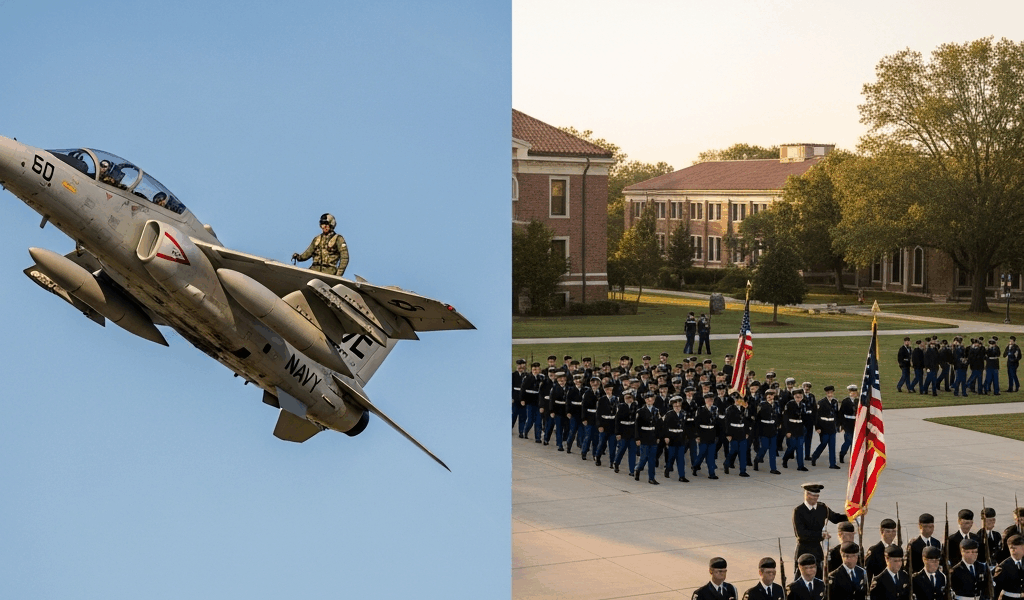
Navy ROTC vs NROTC Scholarship for Pilot Hopefuls
Navy ROTC scholarship decisions involve more than tuition and stipends. Pilot hopefuls also need to understand commissioning requirements, medical qualification, service assignment and the fact that an NROTC scholarship does not guarantee an aviation slot.
What NROTC Actually Gets You as a Pilot Candidate
But what is an NROTC commission, really? In essence, it’s a pathway to becoming an Ensign in the United States Navy or a Second Lieutenant in the Marine Corps. But it’s much more than that — and what it isn’t is a guaranteed ticket into a cockpit.
Here’s how the actual process works. Approaching commissioning, you submit a service assignment preference list ranking the designators you want. 1310 is unrestricted naval aviator. 1320 is naval flight officer. You rank them, a board reviews your full package — class standing, GPA, Physical Readiness Test scores, aviation physical results, available slots that fiscal year — and then the board assigns designators. Your preference list is a wish list. The slot is the prize.
Guaranteed aviation contracts are a different animal entirely. NROTC rarely offers them. Some scholarship contracts include language around aviation intent, but that language does not legally bind the Navy to hand you a pilot slot at commissioning. Don’t confuse stated preference documentation with a hard contract guarantee. If someone tells you otherwise, ask to see the actual contract language — word for word.
The commissioning path itself is fairly straightforward: four years of Naval Science coursework, summer training requirements, PT standards, leadership development, all running alongside your regular degree. Degree field matters less than most people assume for pilot selection. What actually matters is your standing within the unit and your physical qualification status. That’s it.
Scholarship vs Non-Scholarship NROTC Pilot Odds
Probably should have opened with this section, honestly. This is where most applicants make their first serious mistake.
NROTC runs two tracks. Scholarship midshipmen get tuition coverage, a $400 monthly stipend — rising slightly each program year — and textbook allowances. College Program midshipmen, sometimes called non-scholarship mids, self-fund their education and pick up a smaller stipend during their final two years. Both tracks commission officers. Both tracks compete for the exact same designator slots at the same board.
Scholarship status does not directly improve your pilot selection odds. Class rank does. A College Program mid finishing in the top 10 percent of their unit is more competitive for aviation than a scholarship mid sitting comfortably in the middle of the pack. The board sees your whole package — not your funding category.
A genuinely competitive aviation package from NROTC looks something like this:
- GPA above 3.4, ideally in a STEM or technical field
- Top quartile class standing within the unit
- Passed Class 1 aviation physical with zero waivers required
- PRT score in the Excellent or Outstanding range — not just a passing grade
- Real leadership roles within the unit, not just attendance
Vision is a brutal filter. Uncorrected distant visual acuity must be no worse than 20/40 in each eye, correctable to 20/20. PRK surgery — not LASIK — can restore eligibility, but timing is everything and the procedure needs to be completed well before your aviation physical. I’m apparently someone who put off checking the NOMI standards until embarrassingly late, and scrambling to understand waiver timelines in year three never works. Don’t make my mistake. If you’re reading this in glasses right now, look up the current NOMI standards today.
How NROTC Pilot Selection Compares to OCS and the Academy
This is the honest comparison section — at least if you want a straight answer instead of recruiter-friendly talking points. So, without further ado, let’s dive in.
The Navy doesn’t publish unit-level aviation selection rates for NROTC programs. There is no clean table showing NROTC produces X percent pilot designators versus USNA’s Y percent. Anyone citing specific percentages without sourcing a verified DoD report is making numbers up. Full stop.
What we do know structurally:
The United States Naval Academy commissions roughly 1,000 officers annually. They compete for the same designator pool but run through a separate selection process. USNA midshipmen generally carry stronger average academic profiles with more structured leadership development baked in — which tends to favor aviation selection. That said, individual NROTC candidates with elite packages absolutely win aviation slots over weaker USNA graduates. The board isn’t loyal to zip codes.
Navy OCS is the wildcard here. Officer Candidates going through the Aviation Officer Candidate School pipeline are selecting into aviation from day one — that’s a structural advantage NROTC simply doesn’t have. AOCS applicants arrive already pre-screened for flight intent and physical qualification. The tradeoff is real, though: OCS aviation candidates compete against a larger, often more experienced pool, including prior enlisted sailors and college graduates with actual flight hours logged.
That’s what makes NROTC endearing to us pilot hopefuls — time. Four years to build a package, square away your physical, accumulate genuine leadership credibility, and fix problems before any board sees you. OCS gives you weeks. Use what NROTC offers. Don’t coast.
Aviation Physical Requirements You Need Before You Apply
Frustrated by the lack of straight answers available online, I put together this section specifically because my friend didn’t have it when he needed it. Read it carefully.
The Class 1 aviation physical for naval aviators is administered by the Naval Aerospace Medical Institute — NAMI — in Pensacola, Florida. It is not a standard military entrance physical. It is significantly more rigorous, and while most NROTC candidates face it after commissioning, you need to understand the standards before you commit four years to this path. Years before.
Hard disqualifying conditions include:
- Color vision deficiency — no waiver exists for pilots, period
- Hearing loss exceeding specific pure-tone thresholds
- History of certain psychiatric diagnoses or medications, including common ADHD treatments
- Depth perception failures
- Certain cardiovascular findings on EKG
Color blindness ends the pilot dream completely. No exceptions, no waivers, no appeals process worth pursuing. If you have any doubt whatsoever about your color vision, get tested by an ophthalmologist — using Ishihara plates and the Farnsworth D-15 test specifically — before you sign anything or tell anyone you want to fly Navy.
ADHD history and stimulant medication use is a known disqualifier with a complicated waiver process attached. If you were ever prescribed Adderall or Ritalin — even as a child in second grade — disclose it. Hiding medical history and getting caught later isn’t just a medical problem. That’s a career-ending integrity issue. The concealment kills the career faster than the diagnosis ever would.
Which Path Makes More Sense If You Want to Fly Navy
Here’s the actual recommendation, broken down by candidate profile — at least if you’re willing to be honest with yourself about where you stand.
High GPA, strong test scores, physically qualified: Apply for the NROTC scholarship. Compete hard from day one. Use all four years to build a package that makes the aviation designator nearly unavoidable. This is your best structured path outside of a service academy appointment, and it’s a real one.
Average academic profile: Be straight with yourself here. NROTC will commission you — but aviation selection is competitive enough that mid-range grades and mediocre class standing may cost you the designator regardless of how badly you want it. Consider whether OCS aviation matches your profile better, or commit to genuinely improving your standing during those NROTC years rather than assuming the commission carries you somewhere it won’t.
Fastest path to wings: OCS through AOCS. Harder to get into, physical screening happens early, and there’s less runway to fix problems — but if you’re already physically qualified and academically polished, it puts you in Pensacola faster than anything else on this list.
If you’re a high school junior right now, here’s your action step. Schedule a comprehensive eye exam with an ophthalmologist — not an optometrist — and specifically request color vision and depth perception testing. Then call the Professor of Naval Science at the NROTC unit nearest to your target college and ask exactly one question: how many pilot designators did your unit produce at the last commissioning ceremony? That single number tells you more than any glossy brochure ever will.




Leave a Reply