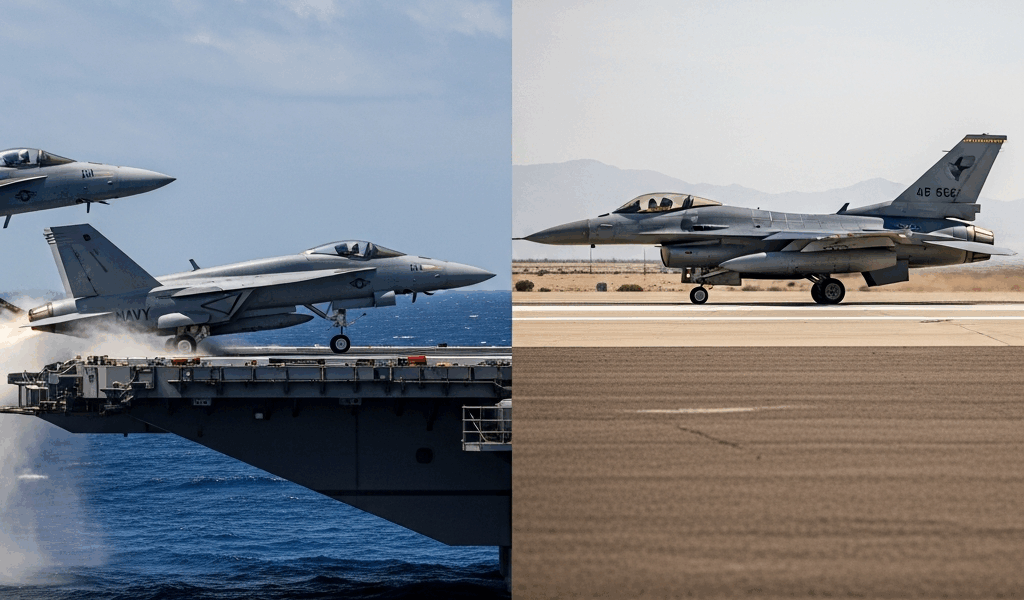
Navy Pilot vs Air Force Pilot — Which Branch Fits You
The navy pilot vs air force pilot decision has gotten complicated with all the recruiting fluff and glossy brochure comparisons flying around. Not a pitch. A real breakdown so you don’t hit year eight full of regret.
How Each Branch Gets You Into the Cockpit
Both branches commission officers through three main pipelines — service academies, ROTC, and Officer Candidate School. On paper, the process looks nearly identical. Underneath that surface, the timing and competition diverge pretty sharply.
The Navy routes you through Aviation Preflight Indoctrination — API — at NAS Pensacola. Six weeks of academics covering aerodynamics, navigation, and physiology before you touch a single stick. There’s also a swim qualification and water survival component. The Air Force has nothing equivalent to that. If water makes you nervous, that’s genuinely useful information to have before you sign anything.
Air Force candidates go through Introduction to Flight Training at Pueblo Memorial Airport in Colorado — usually around 25 hours in a Diamond DA-20, roughly $180 per flight hour in operating costs for the program. It’s essentially a screening filter before the branch commits to the full pipeline investment. Navy screening leans harder on API academics and physical standards rather than early stick time.
Here’s where things really split — the Air Force doesn’t lock you into a specific aircraft until well into undergraduate pilot training. Primary training happens in the T-6 Texan II, then you track-select around the midpoint of UPT into either the T-38 Talon for the fighter/bomber track or the T-1 Jayhawk for mobility and tankers. Navy student naval aviators track-select earlier, with noticeably less flexibility. Jets, props/maritime, or rotary wing — that fork comes before T-45 Goshawk training even begins. The die gets cast sooner. That’s just the reality.
Slot competitiveness is real on both sides. The Air Force has been managing a documented pilot shortage for years, which has occasionally softened selection pressure. Carrier jet billets in the Navy — F/A-18 slots specifically — stay highly competitive and track heavily with class ranking at every training stage. Getting your wings isn’t the finish line. Getting the platform you actually want means finishing near the top, consistently, through the whole pipeline.
Aircraft You Actually Fly in Each Branch
Probably should have opened with this section, honestly. It’s where most people’s real decision lives anyway.
The Navy jet pipeline puts you in the F/A-18E/F Super Hornet or the EA-18G Growler — those are your carrier strike fighter options. Maritime patrol means the P-8A Poseidon, which is essentially a modified Boeing 737 hunting submarines and running reconnaissance missions. Rotary wing pilots end up in the MH-60R Seahawk for anti-submarine work and combat search and rescue, or the MH-60S for vertical replenishment. The E-2C/D Hawkeye handles airborne early warning for anyone drawn to that specific mission set.
The Air Force inventory is broader — both by volume and mission variety. Fighter pilots fly the F-16 Fighting Falcon, F-15C/E, F-22 Raptor, and the F-35A. The heavy side runs C-17 Globemaster IIIs, C-130Js, KC-135s, and KC-46s. Special operations aviation — AC-130, MC-130, CV-22 Osprey — runs through Air Force Special Operations Command and represents a genuinely distinct career track the Navy simply doesn’t replicate. Bomber options include the B-2 and B-52. None of that exists in naval aviation.
But what is the practical implication here? In essence, it’s this: want to fly the F-22, the Air Force is your only path. Want to trap on a carrier at night in the middle of the Pacific, that’s exclusively a Navy experience. But it’s much more than a platform preference — those choices define what your Tuesday looks like for an entire decade.
Deployment Tempo and What Daily Life Actually Looks Like
Carrier deployments run six to nine months. That’s standard. Some stretch longer. A Navy strike fighter pilot attached to a carrier air wing spends roughly a third of their sea tour deployed — and workup cycles pull them away from home for months before the actual cruise even begins. The carrier itself houses around 5,000 people operating continuously. It is not a quiet existence. Not even close.
Air Force pilots deploy on Air Expeditionary Force rotations, historically structured around four to six month cycles with dwell time built in between. Tempo varies significantly by airframe and global demand. F-16 pilots cycling through Bagram during the peak years were moving fast. C-17 crews based at Joint Base Lewis-McChord operated on a fundamentally different rhythm. The Air Force spreads across bases in Montana, New Mexico, Oklahoma, Georgia — the Navy concentrates heavily around Norfolk, Virginia Beach, Jacksonville, San Diego, and Whidbey Island. If your family has strong feelings about coastal cities or genuinely prefers the interior of the country, the Navy removes that choice almost entirely.
Housing quality and morale vary by installation. Navy bases tend to build infrastructure around sea service life. Air Force bases historically invested more in officer club culture and base amenities — though budget cycles have eroded both branches in that area over the past 15 years.
Career Progression and Building the Hours You Want
Flight hours accumulate differently depending on airframe. A Navy F/A-18 pilot coming off a deployment typically logs 200 to 300 hours during that cruise. An Air Force C-17 pilot can hit 300 to 400 hours annually because that jet moves constantly — day and night, worldwide. Fighter pilots in both branches log fewer hours per year than heavy or patrol crews. That gap matters enormously when you’re eventually building an airline application.
The Navy O-4 retention cliff is a documented, well-known phenomenon. Many qualified naval aviators decline to screen for department head — a demanding tour with serious operational responsibility and sustained deployment tempo — and leave at the eight to ten year mark. The timing aligns well with regional airline hiring windows, assuming you’ve managed your hours thoughtfully. The Air Force counters with Aviation Bonus contracts, cash payments that have reached $35,000 annually in recent cycles, attempting to hold pilots through the O-5 zone. Neither branch has actually solved the retention problem. They’re just pulling different levers.
Upgrade timelines to aircraft commander or section lead follow similarly multi-year tracks in both branches. Fleet replacement squadron pipelines move Navy jet pilots into their first fleet squadron fairly quickly — but flight lead qualification takes a full sea tour plus workups. Air Force pilots working toward weapons officer designations move on a comparable timeline. Don’t make my mistake of assuming one branch fast-tracks expertise over the other. It takes the time it takes, regardless of uniform color.
Which Branch Should You Choose Based on Your Priorities
Three types of candidates. Three fairly clear directions.
If carrier aviation is what draws you — the arrested landing, the catapult shot, that specific identity — choose the Navy. Don’t rationalize around it. The carrier is a distinct experience and a distinct culture, and the people who genuinely thrive there usually knew they wanted it before signing anything. That’s what makes the carrier pipeline endearing to the people who choose it.
If you want the broadest platform exposure and maximum flexibility across your flying career, the Air Force wins that comparison. Larger inventory, more varied mission sets, and a track selection process that gives you more runway to figure out what you actually want before you’re locked in. I’m apparently someone who needs options early — and that kind of structure works for me while rigid early commitment never did. If you’re drawn to flying but genuinely unsure whether you want fighters, heavies, or special ops, the Air Force accommodates that uncertainty far better.
If your primary goal is post-military airline career speed and total flight hours, heavy Air Force airframes will build your logbook faster than nearly any Navy community. A C-17 pilot leaving at the ten-year mark with 3,000-plus hours logged is a competitive airline candidate. Naval aviators absolutely transition successfully — but hour accumulation requires more deliberate management throughout the career.
So, without further ado, here’s the bottom line: candidates who pick a branch based on uniform aesthetics or prestige signaling spend a decade resenting the lifestyle they chose. Pick the mission first. Everything else follows from that.
After comparing missions and lifestyle, use the 2026 Navy and Air Force pilot pay comparison to separate common pay from branch-specific bonuses.


Leave a Reply