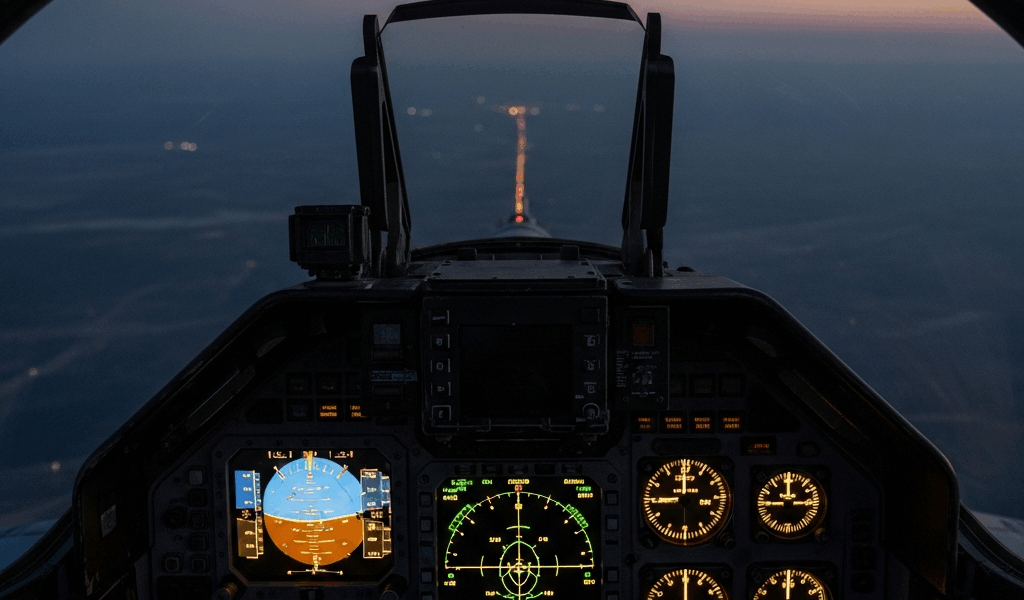
Spatial Disorientation Causes Pilot Error More Than Any Other Factor
I’ve spent enough time reading incident reports to know this cold: spatial disorientation kills more military aviators than mechanical failure, weather, or enemy fire combined. Not because pilots are careless — because the human vestibular system is fundamentally unreliable in three dimensions at speed. The inner ear evolved to walk upright on solid ground. It wasn’t built for a 6G barrel roll at 500 knots in complete darkness.
When you search for spatial disorientation causes, you find academic definitions. Useful. Not enough. What you actually need is the mechanics of how it happens, why standard training misses it, and exactly what works when your body starts lying to your brain at 20,000 feet.
Why the Inner Ear Lies to Fighter Pilots
The vestibular system lives in your inner ear — three fluid-filled semicircular canals that detect acceleration. Simple enough. Except the fluid doesn’t move instantly with your head. There’s lag. A few seconds of lag. During a sustained turn or pitch maneuver, the fluid catches up and stops moving inside the canal, even though you’re still turning. Your brain reads this as “acceleration has stopped” and feeds you false data.
This is called the leans. Probably should have opened with this section, honestly — because it’s the single most common spatial disorientation event in military flight.
Picture a standard 15-degree bank turn in instrument conditions. The first few seconds? Your inner ear nails it. The turn registers correctly. Then the fluid settles. Your brain announces the turn is over. Level wings. But your instruments say you’re still banking at 15 degrees. Your body insists they’re wrong. Most pilots trust their body first. That’s the trap.
The somatogravic illusion makes it worse. Rapid acceleration or deceleration causes your otolith organs — the gravity detectors — to misinterpret the G-forces. A fighter jet pulling 6Gs in a turn doesn’t just increase the G-load. It creates a false horizon. Your inner ear tells you the nose is pitching up when it’s actually level. You unconsciously push the stick forward. Altitude bleeds fast.
High-G turns are the environment where disorientation happens most. F/A-18 pilots routinely pull 5-7Gs in tactical maneuvers. A/10 pilots sustain 5G turns during close air support runs. These aren’t extreme numbers — they’re routine. And they’re precisely where vestibular illusions peak.
Three Disorientation Traps That Cause Real Accidents
Naval Aviation Case 1: F/A-18C, 2007 — Night strike over featureless ocean. The pilot encountered a mild gyroscopic illusion after a series of coordinated turns during weapons delivery. The horizon disappeared. Moonless night. No stars visible through cloud layer. He felt a left wing low sensation. His instruments showed wings level. He rolled right, chasing the feeling. By the time his wingman intervened via radio — pilot had stopped responding to standard calls — he was inverted at 3,000 feet. Recovery was marginal. No ejection needed. Pilot error determination: spatial disorientation — pilot did not trust instruments.
Army Aviation Case 2: UH-60A, 2009 — Dust landing in Afghanistan. Brown-out condition at 40 feet. Pilot initiated a hover to let dust settle. In zero-visibility brown-out, the aircraft drifted. Pilot felt level. Instruments indicated 22-degree roll. He corrected based on body feeling, deepening the bank. The aircraft pitched nose-down. Rotor strike on terrain. Total loss. Crew fatalities: two. Root cause: vestibular conflict in obscured visual environment — pilot over-trusted proprioception in critical phase of flight.
Air Force Case 3: T-37, 1998 — Spin recovery training. Pilot intentionally spun the aircraft. During recovery, the spin stopped. The aircraft was now in a steep dive. The sustained spin had left the pilot severely disoriented. He felt as though the aircraft was climbing. This somatogravic illusion caused him to pull the stick harder, tightening the dive instead of recovering. The instructor pilot took control at 2,000 feet. No crash. Clear takeaway: even expected disorientation in a controlled training environment defeated this pilot’s trust in instruments.
All three incidents share one pattern. The pilot felt something. The instruments showed something else. The pilot chose to believe the feeling. Spatial disorientation doesn’t kill you. Trusting your body instead of your instruments does.
Low-Light and Night Flying Multiply the Risk
Add darkness to disorientation and you’ve created the highest-risk environment in military aviation.
Twilight conditions — that 20-minute window at dusk before full night — produce the highest disorientation accident rate. Your eyes are transitioning between photopic (daylight) and scotopic (night) vision. The vestibular system is confused. Visual cues are degraded but not absent, so pilots try to use them anyway. They’re unreliable. You get false horizon perception. Autokinesis (where a stationary light appears to move). Oculogyral illusions where instrument needles seem to move on their own.
Moonless nights over featureless terrain — ocean, desert, snow fields — remove every visual reference. The pilot has instruments only. Sounds simple. It’s not. When your inner ear is screaming that you’re tilted, and your eyes have literally nothing to reference, and your instruments are the only source of truth, the cognitive load is extreme. Some pilots panic. Some freeze. Some, like the 2007 F/A-18 pilot above, make aggressive corrective inputs based on false vestibular signals.
Modern glass cockpits sometimes worsen this. A large, bright synthetic vision display can feel more real than the artificial horizon beneath it. If you trust the wrong display, or if the display has a subtle lag, or if you misread altitude tape symbology under G-load, you’re hunting a false target with your body signaling something completely different. That cognitive conflict is where accidents live.
Recovery Techniques That Work When Disorientation Hits
This is the section where pilots actually want to know what to do.
Step one: Announce it. “I am disoriented. I am going instruments only.” Say it out loud. This forces cognitive acceptance that your body is unreliable. Your wingman, your instructor, or your crew can now support the recovery. Pride kills pilots here. Most disoriented pilots never admit it.
Step two: Ignore the inner ear. Completely. Not partially. The vestibular system will continue sending false signals for several minutes, even after you’ve identified disorientation. You must override the impulse to correct based on feel.
Step three: Level the wings on the artificial horizon. Not the compass. Not intuition. The attitude indicator. Hands on, cross-check with the ball and turn needle. Pitch attitude: nose on the horizon line. Wings: perpendicular to the horizon line. Simple inputs. Small corrections.
Step four: Establish a descent or climb based on the altimeter and vertical speed indicator. Don’t guess. Don’t feel. Read. Instrument interpretation under disorientation is difficult — your eyes are shaking, your hands may be shaking, cognitive load is maxed out. Slow down. Triple-check altitude.
Step five: If possible, hand over control to another pilot. Not as failure. As procedure. A fresh nervous system with a clear mind can interpret instruments faster than someone whose balance system is overloaded.
The psychological barrier is real. Military culture emphasizes control and confidence. Admitting disorientation feels like incompetence. Pilots who overcome this mindset live longer.
Training Gaps Beyond the Altitude Chamber
Standard spatial disorientation training — the altitude chamber, the APIT device, the spin trainer — exposes pilots to disorientation in controlled settings. Necessary. Not sufficient.
Simulator training is limited. Full-motion sims can replicate vestibular illusions to a degree, but not completely. The motion cues in a sim are attenuated. Real flight is unforgiving. A pilot trained in the sim to recognize the leans still might not trust instruments when the sensation is happening in actual flight with real G-forces and real altitude loss consequences.
The gap: instrument-only recovery under physiological stress. Most pilots train instrument flying in stable, low-threat scenarios. They need to practice recovery procedures while their balance system is actively providing false information. This requires actual flight or high-fidelity centrifuge training, which is expensive and rare.
Cross-training helps. Helicopter pilots who fly in brown-out conditions develop faster vestibular calibration. Fighter pilots with extensive instrument-only night flight hours show higher disorientation recovery rates. The common element: repeated exposure to environments where instruments are the only reliable reference.
Self-awareness matters more than most training emphasizes. Know your own vestibular sensitivity. Some pilots are naturally resistant to disorientation. Others are susceptible. Know which you are. Fatigue, hypoxia, dehydration, and G-stress all degrade vestibular performance. Manage these inputs before flight.
Spatial disorientation won’t disappear. The inner ear can’t be rewired. But pilots who understand the mechanism, who practice deliberate recovery procedures, and who trust instruments over sensation live to fly another mission.

Leave a Reply