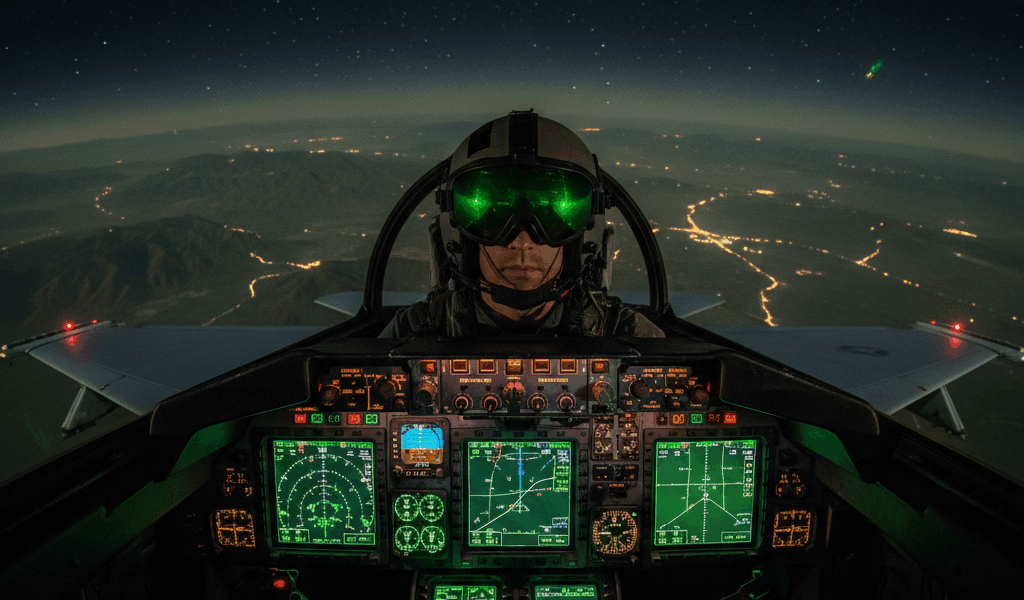
Night vision goggle flying is not ordinary night flying with a brighter view. Aviation NVGs change the visual information available to an aircrew: they amplify compatible near-infrared and visible light, narrow the field of view, alter depth and distance cues, and interact with cockpit lighting, weather, terrain, and artificial illumination. Safe military NVG operations therefore depend on aircraft-specific equipment, formal qualification, disciplined scanning, crew coordination, mission planning, and recurring proficiency.
This overview explains what aviation NVGs provide, what they do not provide, and why military aircrews train their limitations as seriously as their capabilities. It is educational—not a substitute for an approved flight manual, service publication, unit standardization program, instructor, or current regulation.
What NVGs Do in an Aircraft
Aviation night vision goggles use image-intensification tubes to turn very low levels of ambient energy into a visible image. The system collects available light, converts and amplifies it, then presents an intensified scene through the eyepieces. The familiar green or white-phosphor appearance is a display characteristic; it is not natural color vision.
That intensified outside scene can help an equipped and qualified crew identify terrain, obstacles, coastlines, cultural lighting, formation references, landing areas, and other cues that may be difficult to see unaided. It does not make darkness equivalent to daylight. Performance changes with illumination, cloud cover, atmospheric obscuration, shadows, light sources, equipment condition, adjustment, and the spectral compatibility of the aircraft.
Military NVG capability is part of a larger night vision imaging system (NVIS). The goggles, helmet mounting, aircraft lighting, displays, filters, maintenance program, crew procedures, and training must work together. A pair of goggles alone does not make an aircraft NVG-compatible.
Why the View Feels Different
Restricted field of view
Natural binocular vision covers a broad scene, while typical goggles present a much narrower circular view. The FAA’s NVG rulemaking research review found that decreasing field of view increases workload and can degrade task performance. Aircrews compensate with deliberate head movement and a continuous scan rather than staring through the center of the tubes.
Depth, distance, and closure cues
Distance estimation and depth perception can be altered through NVGs. The effect becomes especially important near terrain, obstacles, other aircraft, and landing surfaces. An official U.S. Air Force account of helicopter NVG training describes students learning that distance estimation, depth perception, and relative-motion vision may change while using goggles.
Brightness, blooming, and shadows
Bright cultural lighting, strobes, fires, reflections, or another aircraft’s lights can dominate part of the intensified image. Automatic gain control helps protect the display, but a bright source can still reduce the usable detail elsewhere. Deep shadows can hide features even when an adjacent area looks clear.
Weather and obscuration
NVGs do not see through cloud, fog, dust, smoke, precipitation, or other obscuration. Some conditions can appear deceptively benign until visual cues deteriorate. Weather avoidance, instrument proficiency, aircraft systems, and approved procedures remain essential.
Cockpit Lighting and NVIS Compatibility
Unfiltered or incompatible cockpit lighting can overwhelm goggles, create reflections, reduce outside-scene contrast, or make instruments difficult to read. NVIS-compatible aircraft use approved lighting and display solutions designed so the crew can see required information without excessively degrading the intensified outside view.
Compatibility involves more than setting panel lights to minimum. Portable devices, flashlights, warning lights, formation lights, head-up displays, and modifications can all affect the environment. Equipment configuration and lighting checks belong in approved procedures and maintenance—not improvised cockpit experimentation.
Aircrews also need an effective transition between the goggle view and unaided or instrument references. The scan changes with aircraft design, crew position, symbology, workload, and mission phase.
What NVG Qualification Training Covers
Programs differ by service, aircraft, and mission, but qualification normally builds from academics to hands-on equipment work, simulator or training-device events where available, and supervised flight. A U.S. Air Force NVG academic instructor course divides instruction among eye physiology, technology, focus and adjustment, demonstrations, the operating environment, misperceptions and illusions, and human factors.
Typical training areas include:
- equipment inspection, mounting, focus, adjustment, and limitations;
- normal and emergency procedures;
- cockpit and exterior-lighting compatibility;
- visual scanning, fixation avoidance, and crew cross-check;
- illumination, shadows, contrast, weather, and terrain interpretation;
- takeoff, approach, landing, go-around, and aircraft-specific maneuvers;
- crew resource management, task sharing, and communication;
- inadvertent loss of visual cues and transition to instruments;
- mission-specific formation, low-level, shipboard, or confined-area training when authorized.
The Air Force’s published training examples describe a crawl-walk-run progression and the continuing need to maintain proficiency. Training devices can build recognition and procedures, but operational programs still define required aircraft events, instructor standards, currency, and evaluation.
NVG Mission Planning Factors
Night vision planning considers not just sunset and weather, but the quality and distribution of visual information along the route and at the objective or landing area.
- Illumination: moon phase, elevation, azimuth, cloud cover, shadows, and expected cultural lighting.
- Weather: ceilings, visibility, precipitation, obscuration, winds, temperature, and changing conditions.
- Terrain and obstacles: relief, wires, towers, vegetation, landing-area boundaries, and escape options.
- Aircraft configuration: approved NVIS configuration, lighting, displays, goggles, batteries, mounts, and mission equipment.
- Crew plan: duties, callouts, sterile-cockpit periods, instrument cross-check, transfer of control, and response to degraded imagery.
- Alternates: abort criteria, divert options, fuel, weather changes, and loss of NVG capability.
Ambient illumination is only one input. A high-illumination night can still produce difficult shadows, while some low-illumination scenes may retain usable contrast. Crews use the planning methods and tools approved for their aircraft and organization rather than assuming a single moon percentage predicts performance.
Human Factors in NVG Flight
NVG flight combines restricted vision with normal aviation workload. Fatigue, fixation, task saturation, poor focus, incorrect interpupillary adjustment, pressure points, neck strain, and an undisciplined scan can reduce performance. The weight and balance of helmet-mounted equipment also matter during long missions or high-workload maneuvering.
Aircrew physiology remains relevant. The FAA Aeronautical Information Manual notes that vision under dim illumination is sensitive to lighting and dark adaptation, and that hypoxia affects night vision before some other symptoms become obvious. Military units apply their own oxygen, fatigue, medication, and fitness-for-flight standards.
Good crew coordination creates redundancy. One crewmember’s intensified view should not replace instrument cross-check, navigation systems, radar or sensors when available, or another crewmember’s independent assessment. Callouts need to be standardized and unambiguous because a visual cue obvious to one person may not be visible through another set of tubes.
Common NVG Misconceptions
- “NVGs turn night into day.” They provide an intensified monochromatic image with important limitations.
- “If terrain is visible, weather is safe.” Visibility through goggles does not replace weather minimums or instrument procedures.
- “More ambient light is always better.” Lighting distribution, shadows, contrast, and bright sources can matter as much as total illumination.
- “Any cockpit can use aviation goggles.” Aircraft lighting and equipment must be approved and compatible.
- “Currency equals proficiency.” Meeting a minimum event requirement does not guarantee readiness for every mission or condition.
Military and Civil NVG Rules Are Not Interchangeable
Military aircrews operate under service regulations, aircraft publications, unit programs, and mission authorities. Civil pilots operate under applicable FAA regulations and approvals. For context, the FAA’s current endorsement guidance in Advisory Circular 61-65J includes separate ground-training, flight-training, proficiency, and instructor endorsements for NVG operations.
Those civil requirements should not be used to infer a military qualification syllabus, and military experience does not automatically satisfy every civil requirement. Pilots should verify the current authority that applies to the specific operation.
The Operational Bottom Line
NVGs can expand night capability, but they do so by presenting a different visual environment—not by removing nighttime risk. The enduring skills are disciplined scanning, instrument cross-check, aircraft control, crew coordination, accurate mission planning, and an early transition to approved alternatives when the intensified image no longer supports safe flight.
For background on the equipment’s evolution, read how night vision technology changed military aviation. For the human-performance side, see our guide to aviation physiology and military flight.

Leave a Reply