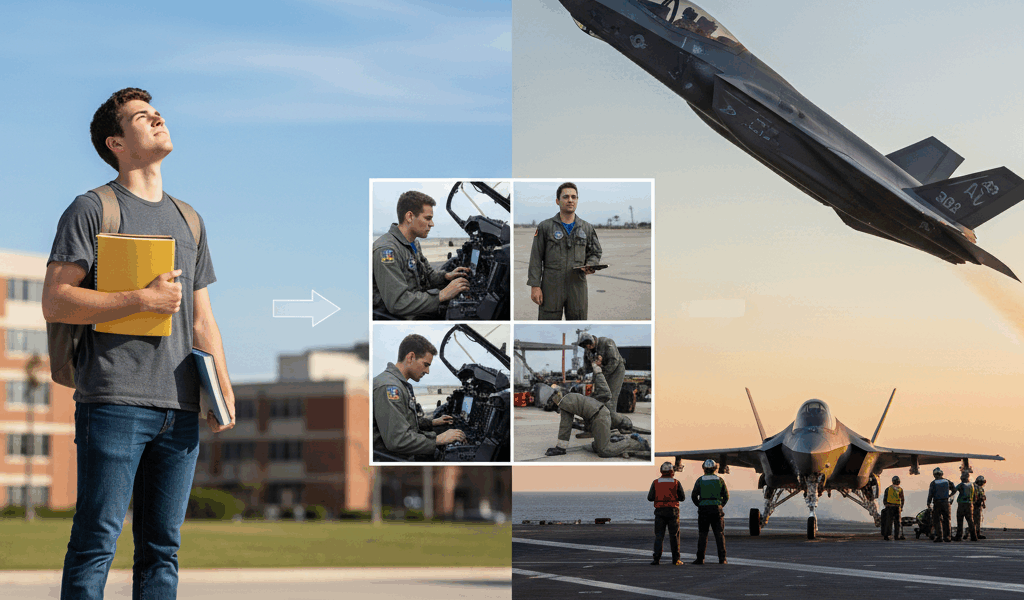
From Civilian to Fighter Pilot – The Complete Timeline
Becoming a fighter pilot has gotten complicated with all the training phases and qualification requirements flying around the military aviation pipeline.
Transforming from a civilian into a combat-ready fighter pilot requires approximately four to six years of intensive training that never lets up. Understanding this timeline helps aspiring aviators plan their careers and set realistic expectations for the journey ahead—because it’s longer than most people realize.

Officer Training (3-12 months)
Probably should have led with this section, honestly. Every military pilot must first become an officer before they touch an aircraft. Candidates choose between service academies (4 years of full immersion), ROTC programs (4 years concurrent with college coursework), or Officer Training School (approximately 3 months for college graduates who came to this late). Each path produces commissioned officers eligible for flight training, though the experiences differ dramatically.
Initial Flight Screening (2-3 weeks)
New officers reporting for pilot training complete initial flight screening to verify basic aptitude before anything serious begins. This phase weeds out candidates who struggle with the fundamental demands of military aviation before significant resources are invested in their training—better to find out now than later.
Undergraduate Pilot Training (12-18 months)
That’s what makes UPT so intense—the core of military pilot development occurs during undergraduate pilot training where everything comes together. Students progress through ground school, simulator training, and increasingly complex flight phases that build on each other. Successful completion earns pilot wings and establishes the foundation for advanced training, but getting there requires passing every check along the way.
Introduction to Fighter Fundamentals (6 months)
Students selected for fighter assignments attend additional training focused on air-to-air and air-to-ground tactics that separate fighter pilots from everyone else. This phase introduces combat maneuvering, weapons employment, and the aggressive flying that defines fighter aviation. It’s where you learn to think like a fighter pilot rather than just fly like one.

Fighter Training Unit (6-9 months)
New fighter pilots report to training squadrons operating their assigned aircraft type where they finally meet the jet they’ll spend years flying. Whether F-16s, F-15s, F-22s, or F-35s, pilots learn the specific systems, tactics, and employment techniques unique to their platform until they know every switch and procedure cold.
Mission Qualification (3-6 months)
Arriving at operational squadrons, pilots complete mission qualification training under experienced wingmen who’ve done it all before. This final phase transforms trained pilots into combat-ready aviators cleared for deployment to actual operations where it counts.
Ongoing Development
The learning never stops no matter how experienced you get. Fighter pilots continuously train in advanced tactics, attend weapons school when selected, and accumulate experience that builds expertise over entire careers spanning decades. The timeline to basic qualification represents merely the beginning of a lifelong pursuit of excellence that defines this profession.
Total elapsed time from civilian to combat-ready fighter pilot typically spans five to six years, representing one of the most demanding professional development programs in existence. Those who make it through earn something that can’t be taken away.

Leave a Reply