Night Vision Technology and How It Changed Military Aviation
Night vision has gotten complicated with all the advanced sensors and integrated helmet systems flying around modern military cockpits.
Night vision technology transformed military aviation from a daylight-only enterprise into a 24-hour capability that enemies can’t escape. Modern military pilots operate as effectively in complete darkness as their predecessors did under bright sunshine, which is something that would have seemed impossible just a few decades ago. This revolution in capability fundamentally changed how air campaigns are planned and executed around the world.

How Night Vision Works
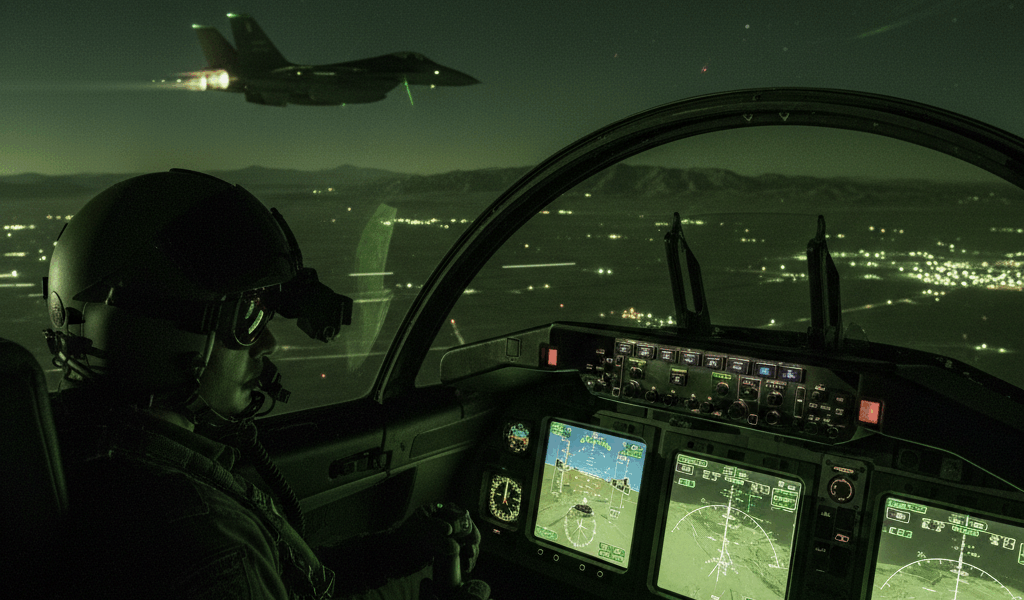
Probably should have led with this section, honestly. Image intensification tubes amplify available light thousands of times, converting starlight and moonlight into usable imagery that pilots can actually work with. Even on the darkest nights with heavy cloud cover, enough ambient light exists for these systems to create workable visual pictures. Pilots see a green-tinted world that, while very different from daylight flying, provides sufficient detail for safe flight operations and tactical awareness.
Forward-looking infrared systems offer an alternative approach that works differently entirely, detecting heat rather than visible light. These sensors reveal warm objects against cooler backgrounds, making vehicles, aircraft, and people visible regardless of lighting conditions or time of night. Modern helmets can fuse both technologies together for optimal situational awareness that gives pilots the complete picture.
Integration Challenges
Early night vision goggles simply strapped to existing helmets without much thought to ergonomics, creating heavy, unbalanced headgear that strained pilot necks during maneuvering and left everyone sore after long missions. Modern integrated helmet systems distribute weight properly across the head and provide seamless transitions between visual modes without the pilot having to think about it.
That’s what makes cockpit integration so challenging—it required complete redesign for night vision compatibility. Displays that appear normal to the naked eye overwhelm intensification tubes, creating dangerous glare that blinds rather than helps. Every instrument, switch, and indicator had to be modified for night vision operations, which meant rethinking cockpit design from the ground up.

Tactical Advantages
Night operations offer significant tactical advantages that commanders learned to exploit ruthlessly. Enemy forces without comparable technology become vulnerable after sunset in ways they simply cannot counter. Air defense crews struggle to acquire targets they cannot see with their own eyes, while pilots with night vision maneuver freely through darkened skies like it’s midday.
Surprise attacks launched in darkness exploit human circadian rhythms that even well-trained troops can’t overcome. Defenders operating at reduced capacity during their natural sleep hours face attackers at peak performance who’ve planned for this exact moment. This asymmetric advantage drove investment in night vision technology for decades and continues to pay dividends.
Training Requirements
Flying with night vision demands specific training that regular flight hours simply don’t provide. Depth perception changes in ways that surprise new users, peripheral vision narrows significantly compared to daylight flying, and visual illusions occur in ways that daylight flying never presents no matter how experienced you are. Pilots must learn to trust instruments when visual cues conflict with physical sensations, which goes against natural instincts.
The night vision revolution continues as newer technologies provide better resolution than ever before, wider fields of view that approach natural vision, and seamless sensor fusion that combines multiple data sources. Military aviation will remain a 24-hour enterprise for the foreseeable future, and the pilots who master these systems will always have the advantage over those who can’t fight in the dark.
Technology only becomes operational capability through compatible aircraft, trained crews, and disciplined procedures. See our NVG flying and night vision operations guide for the cockpit, training, and human-factor details.

Leave a Reply