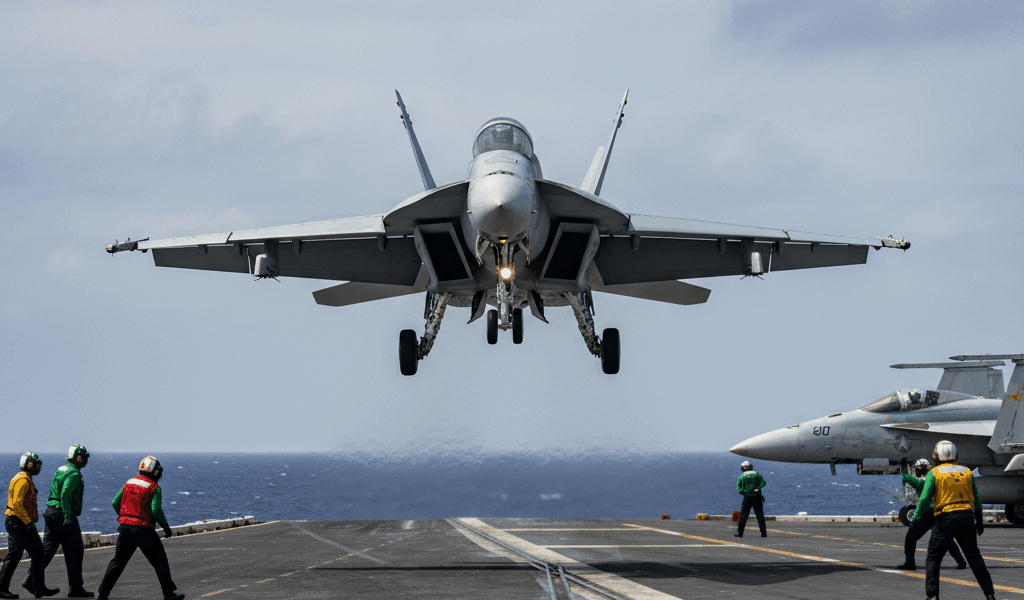
Why Navy Pilots Must Master Carrier Landings
Carrier landings have gotten complicated with all the precision requirements and variables flying around naval aviation.
Landing on an aircraft carrier represents the ultimate test of precision flying that exists anywhere in aviation. Navy pilots spend countless hours perfecting this skill because even small errors can prove fatal when touching down on a moving deck in the middle of the ocean with nowhere else to go.
The landing area on a Nimitz-class carrier measures roughly 500 feet long and 100 feet wide—that’s it. Compare this to a typical runway of 10,000 feet or more, and the challenge becomes painfully clear. Pilots must hit a precise spot every single time without exception.
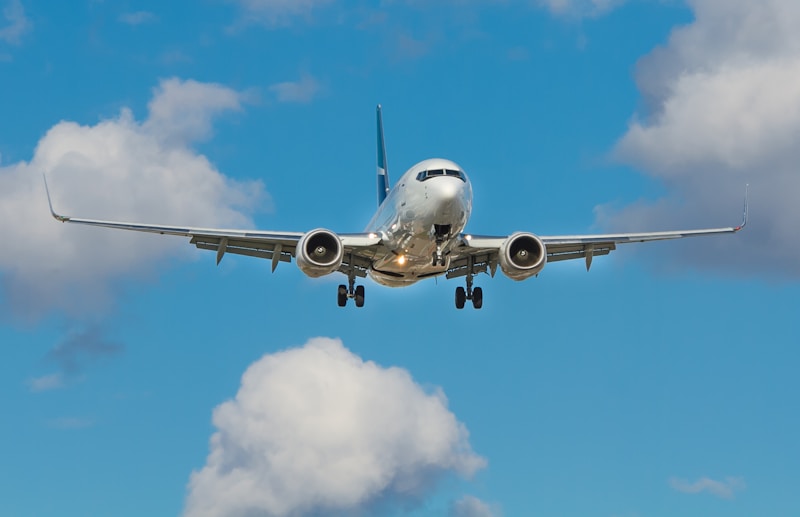
Probably should have led with this section, honestly. The approach itself demands constant adjustment that never lets up. Pilots follow a glide slope indicated by a Fresnel lens optical landing system while compensating for ship movement, wind gusts, and their own aircraft configuration all at once. The meatball, as pilots call the visual reference, must stay centered throughout the approach or you’re in trouble.
That’s what makes tailhook engagement so critical—it marks the moment of truth. The hook must catch one of four arresting wires stretched across the deck to stop a jet going over 100 knots. Missing all four results in a bolter, requiring an immediate go-around for another attempt while you wonder what went wrong.
Night carrier landings add another dimension of difficulty that separates the truly skilled from everyone else. Pilots descend into near-total darkness, trusting their instruments and the ship’s lighting systems to guide them to a safe touchdown on a postage stamp floating in black water.
Student naval aviators practice carrier qualifications extensively before earning their wings because there’s no faking this skill. The stress and precision required for carrier operations produce pilots capable of performing under the most demanding conditions imaginable—if you can land on a carrier at night in bad weather, you can handle anything.
This singular skill separates naval aviators from their Air Force counterparts and creates a brotherhood forged on pitching decks worldwide that only those who’ve done it truly understand.


Leave a Reply