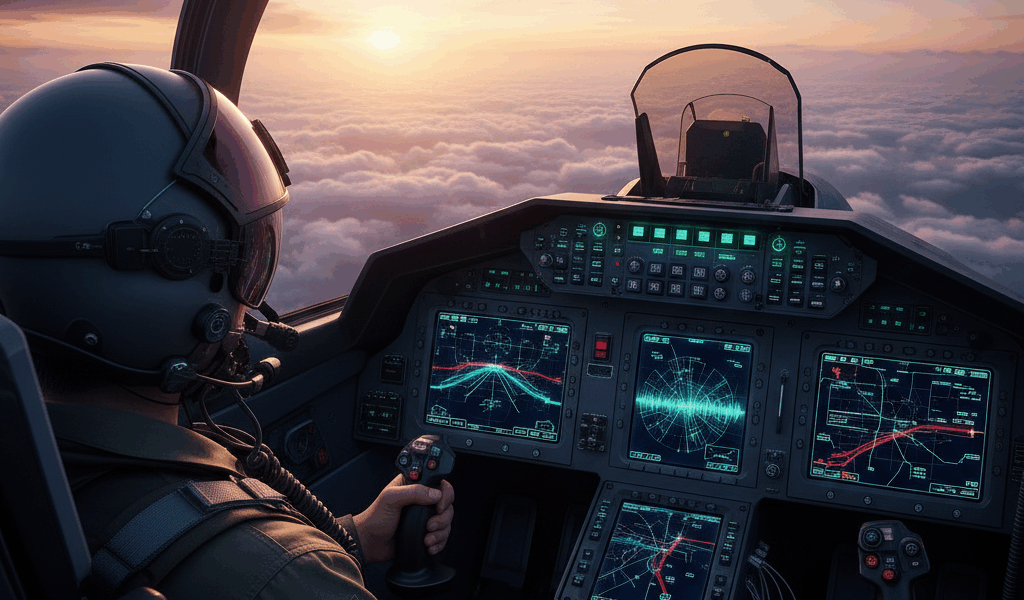
Electronic Warfare and How Modern Pilots Fight in the Invisible Spectrum
Electronic warfare has gotten complicated with all the advanced sensor systems and detection technology flying around these days.
The real battle in modern air combat happens where visibility is zero. Flying at 500 knots through airspace filled with radar signals, communications networks, and electronic systems all designed to take you out changes how you think about survival completely. Electronic warfare isn’t some abstract theory you read about in manuals—it’s the reality of staying alive when contested skies are doing everything possible to find and eliminate you.
I’ve talked to pilots who’ve flown the F-35 in environments where threats lurk everywhere. They describe a fundamentally different experience than what peacetime training prepares you for. There’s no visible enemy bearing down on you. Instead, you’re managing warning signals, constantly adjusting your flight path to avoid detection, and trusting systems that tell you where threats originate from. Your radar stays off most of the time. Your radio stays encrypted and minimal because every transmission could give you away.
Everything Has an Electronic Signature
Probably should have led with this section, honestly. Your radar transmits energy that guides your shots—but here’s the catch: enemies hear that same transmission and know exactly where you are. Your radio calls coordinate actions with your wingman but expose your position to anyone listening. Engine heat, skin reflections, even cockpit displays create signatures that show up on hostile sensors waiting to track you. Modern combat pilots constantly balance these trade-offs: What signals am I putting out right now? What does that reveal to enemies who want to kill me?
Enemy systems broadcast their locations too, which creates interesting dynamics. When adversary radars transmit, your warning systems hear them instantly. That’s the advantage you’re playing for. Stealth aircraft operate differently than anything that came before—they stay quiet, listen passively, and know where threats are without broadcasting their own presence. It’s like operating in the dark while your enemies are walking around with flashlights giving away their positions.
Those Warning Tones Become Instinct
Every fighter pilot knows those sounds intimately. The warble indicating someone has you on track. The urgent pulse that means a missile just launched at you. These aren’t theoretical warnings you casually acknowledge—they’re basically your nervous system manifesting in the cockpit. Pilots describe these tones becoming automatic responses, almost instinctive after hundreds of training hours drilling them into muscle memory. Your brain learns to interpret danger faster than conscious thought can process what’s happening.
That’s what makes Growler pilots special. They fly electronic warfare versions of the Super Hornet and actively hunt enemy radar sites, launching anti-radiation missiles at emitters while their jamming systems degrade radar performance across wide areas. It’s offensive warfare at its finest—intentionally targeting the sensors trying to track friendly aircraft. These pilots represent a different breed entirely: electronic combat specialists who thrive in the invisible spectrum.
Stealth Changes the Fundamental Game
The F-35 altered electronic warfare entirely when it entered service. Previous fighters had to manage their signatures carefully or run away when things got hot. The F-35 prevents detection in the first place. It’s not about overpowering sensors with brute force—it’s about not appearing on enemy radar at all. Operating this aircraft demands strict emission control: radar off unless absolutely necessary, radio silent whenever possible, every single transmission calculated for necessity rather than convenience.
Pilots flying the F-35 see enemies before enemies see them. That advantage translates directly to winning before combat even starts, which fundamentally changes how you approach missions.
But stealth requires discipline that not everyone appreciates. You can’t casually turn systems on because you feel like getting more situational awareness. Every radar pulse creates risk that compounds over time. That mental shift—from “use all sensors available” to “minimize every transmission possible”—represents fundamental change in how pilots operate and think about combat.
Artificial Intelligence Will Transform This
Electronic warfare specialists I’ve talked to know AI will eventually manage these systems faster than humans ever could. Imagine AI analyzing enemy emissions in real-time, identifying vulnerabilities before you even notice them, deploying countermeasures automatically—while the pilot focuses on the bigger mission picture. That technology is coming sooner than most people realize. It’s going to fundamentally change air combat in ways we’re only beginning to understand.
Training is Complex and Technical
Electronic warfare training separates serious fighter programs from everyone else in the world. Pilots need to understand radar propagation, signal processing, jamming theory—fundamentally electrical engineering concepts that most people never encounter. A fighter pilot operating in contested airspace without solid EW knowledge is essentially flying blind and hoping for the best.
Simulators teach most of it because real threat systems can’t be safely replicated in actual flight without serious risk. Advanced simulators recreate sophisticated adversary systems with incredibly high fidelity that approaches real-world accuracy. Pilots practice against realistic threats repeatedly until responses become automatic and instinctive. Red Flag exercises at Nellis Air Force Base provide experience against actual threat replicators—invaluable training that pays dividends when deployment actually happens.
The invisible spectrum where electronic warfare occurs might lack the drama of dogfighting that people imagine when they think about air combat, but everything that happens in that spectrum determines who comes home when the mission ends. That’s the reality pilots live with every time they strap in.


Leave a Reply