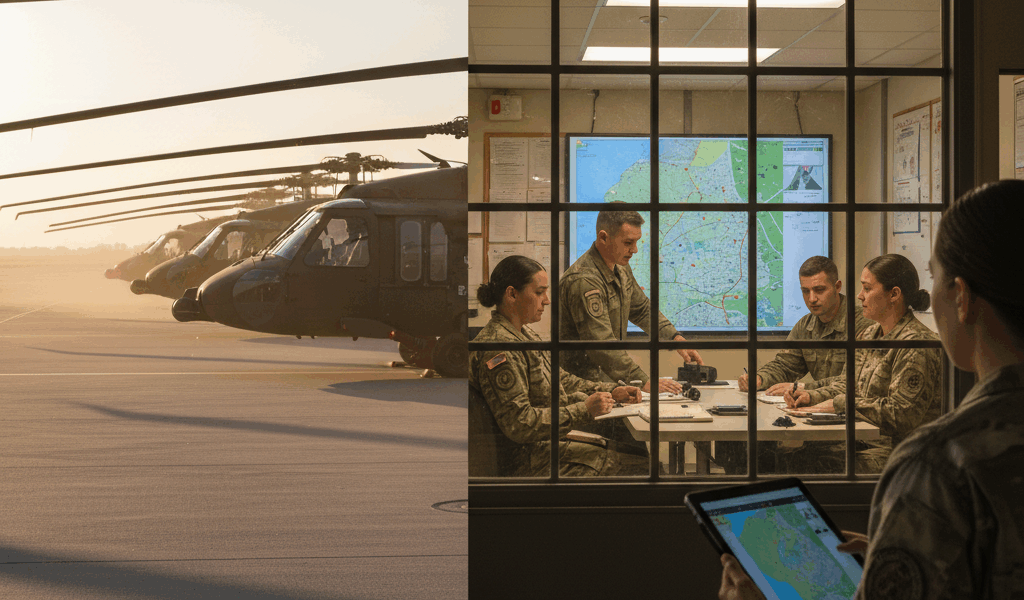
Army flight school does not have one guaranteed start-to-finish timeline. Students complete entry-path requirements, Initial Entry Flight Training Common Core in the UH-72 Lakota, and advanced training in an assigned Army aircraft. Holds, aircraft availability, maintenance and the advanced airframe can extend the calendar substantially.
The Army reported in July 2025 that some students from the 2023 year group were still waiting to complete flight school and that training could exceed two years. In 2026 the Aviation Center of Excellence also announced continuing changes under Flight School Next. Treat any fixed “12-month” or “18-month” promise as an estimate, not a current Army guarantee.
Current sequence: complete the requirements for your commissioned or warrant-officer path → report to Fort Rucker, Alabama → complete Initial Entry Flight Training Common Core in the UH-72 → receive an aeronautical rating under the current policy → complete advanced aircraft training → graduate and report to the gaining unit for continued progression.
Army flight-school timeline at a glance
| Stage | What happens | Why the calendar varies |
|---|---|---|
| Before flight training | Commissioning or warrant-officer accession, medical qualification and required military education | Entry source, component, scheduling and prerequisites differ |
| Initial Entry Flight Training Common Core | Academic, simulator and UH-72 flight training leading to the current aeronautical-rating milestone | Weather, aircraft, maintenance, instructor and class scheduling affect progress |
| Advanced aircraft training | Training in the assigned advanced airframe and its mission systems | Airframe course length, seats and fleet availability differ |
| Graduation and unit progression | Transition to the gaining unit and continued readiness-level progression | Formal school completion is not the end of unit qualification and mission training |
Where Army flight school takes place
The Army Aviation Center of Excellence and its principal flight-training organizations are at Fort Rucker, Alabama. The installation was named Fort Novosel from 2023 until its name reverted to Fort Rucker in 2025. Current searches and Army pages may contain both names because older documents retain the name in effect when published.
Do not confuse a historical “Fort Novosel” reference with a different school. Check current orders, reporting instructions and the official Fort Rucker site for arrival details.
Step 1: reach the flight-training pipeline
Warrant officers and commissioned officers can both become Army aviators, but they do not arrive through an identical accession path. A warrant-officer candidate may complete Warrant Officer Candidate School and the applicable professional military education. A commissioned officer reaches aviation through an officer-accession source and branch process.
The two careers also differ after flight school. Our Army warrant officer versus commissioned pilot guide compares role and career structure. It should not be used to predict a personal report date.
Applicants must satisfy the current prerequisites for their path. For 153A warrant-officer applicants, the Army recruiting page identifies requirements involving the SIFT, GT score, age, flight physical, recommendations and application packet. See our current Army SIFT requirements guide and verify the official recruiting checklist before submitting.
Step 2: Initial Entry Flight Training Common Core
Common Core develops the common knowledge and flight skills required before students move to an advanced Army aircraft. The current training model uses the UH-72 Lakota for initial rotary-wing training. The TH-67 Creek was replaced; a timeline that still assigns modern students to the TH-67 is describing an obsolete pipeline.
Common Core incorporates academics, simulators and live flight. Students build knowledge and skills in areas such as aircraft systems, aerodynamics, regulations, weather, planning, visual flight, instrument flight, navigation, emergency procedures and basic warfighting skills. The exact sequence and syllabus are controlled by the Army’s current program of instruction.
In July 2026, the Army announced that an initial class had begun solo cross-country missions in the UH-72 during the Basic Warfighting Skills phase. That illustrates why an old week-by-week outline can become inaccurate even when the overall Common Core structure remains recognizable.
Step 3: aeronautical rating and the 10-year service obligation
A major policy change affects how students should understand the timeline. The Army announced in July 2025 that, under MILPER Message 25-264, the aeronautical rating date for affected officers and warrant officers is issued at completion of the Initial Entry Flight Training Common Core phase.
The Army said the 10-year active-duty service obligation for aviators selected for flight training in fiscal year 2021 and later now begins at that Common Core aeronautical-rating milestone, with the policy applied retroactively to aviators who entered initial entry flight training on or after October 1, 2020.
This change was made because advanced-airframe backlogs could add substantial time before final flight-school completion. Candidates should read the current service agreement and personnel message applicable to their component; an article cannot interpret an individual contract or obligation.
Step 4: advanced aircraft training
After Common Core, students continue into training for an assigned advanced Army aircraft. Potential fleets include variants of the UH-60 Black Hawk, AH-64 Apache and CH-47 Chinook, subject to Army requirements and the training program in effect.
Do not plan around an unofficial promise that a particular airframe course always lasts a certain number of weeks. The Army specifically cited AH-64 maintenance challenges as a contributor to a significant flight-school backlog in 2025. Seats, aircraft availability, syllabus changes and class throughput can change between selection and training.
Airframe assignment is also not simply a consumer choice. Army needs, component and unit requirements, available seats, qualifications and applicable class procedures affect the result. Ask the current training chain how assignments are made for your cohort.
What causes flight-school delays?
- aircraft maintenance and availability;
- instructor and simulator capacity;
- weather and airfield interruptions;
- class scheduling and holds between phases;
- medical or administrative interruptions;
- advanced-airframe seat availability;
- syllabus changes and Army training redesign; and
- individual retraining or setback decisions.
A hold does not automatically mean the student is failing. The Army’s 2025 service-obligation announcement explicitly described systemic training delays that were not the student’s fault.
Flight School Next: why 2026 timelines may keep changing
Army Aviation is redesigning initial flight training. In January 2026 the Aviation Center of Excellence described a potential commercially owned and operated initial training model followed by advanced-aircraft training at Fort Rucker. In April, Army leaders said the service was preparing to redesign flight school after a pilot program.
Until new programs are formally implemented for a student’s class, use current orders and schoolhouse instructions—not a proposal—as the authority. The present public reporting still describes UH-72 Common Core training, while Flight School Next signals that future cohorts may follow a different sequence.
What happens after graduation?
Graduating formal flight training and earning Army aviator wings are major milestones, but they do not make a new aviator fully mission-qualified in every unit task. The gaining unit continues aircraft and mission progression under current Army aviation training requirements.
That distinction matters when comparing Army flight school with a civilian certificate or another service’s undergraduate pilot training. Army training is part of a military accession and unit-readiness system, not merely a stand-alone helicopter course.
How to plan realistically
- Verify the entry path. Separate WOCS or commissioned-officer requirements from flight-school time.
- Use a range, not a graduation promise. Housing, family and financial plans should tolerate holds.
- Read the service obligation. Confirm when the obligation starts for your class and component.
- Keep medical documentation current. Review the military pilot eyesight and aviation-physical framework before assuming a condition is resolved.
- Follow official reporting instructions. Installation names, units and schedules can change.
- Expect continued unit training. Formal graduation is not the final readiness milestone.
Bottom line
The current Army helicopter pilot pipeline moves from the applicant’s officer or warrant-officer entry requirements into UH-72 Initial Entry Flight Training Common Core, then advanced aircraft training and unit progression. The Army has publicly acknowledged that backlogs can push completion beyond two years for some cohorts, so no unofficial phase calendar should be treated as guaranteed.
Use the current Fort Rucker reporting instructions, Army recruiting checklist, schoolhouse program and service agreement for personal decisions. The pipeline is also changing under Flight School Next, making current official information more important than recycled TH-67 timelines.




Leave a Reply