Air Force Pilot Vision Standards Have Gotten Complicated with All the Misinformation Flying Around
As someone who has spent years researching military aviation medical standards, I learned everything there is to know about what actually disqualifies a pilot candidate — and what doesn’t. Today, I will share it all with you.
Here’s the thing most people get completely backward: uncorrected vision doesn’t automatically knock you out of the running. Not even close. The Air Force maintains specific thresholds for both uncorrected and corrected vision because pilots need to process visual information fast — sometimes at speeds and stress levels most of us will never experience. But the standards are more forgiving than the internet would have you believe.
The distinction between uncorrected and corrected matters enormously. Uncorrected vision is your raw eyesight — no glasses, no contacts, nothing. Corrected vision is what you get after putting your prescription on. The Air Force cares about both. For different reasons. They want to know what your eyes do naturally, and they want to confirm your corrected vision reliably hits operational standards.
Role matters too. A fighter pilot candidate faces stricter requirements than a navigator. Remotely piloted aircraft operators — drone pilots — work within a completely different set of parameters. The airframe factors in as well. Not all pilot tracks demand identical thresholds. This isn’t bureaucratic padding collecting dust in a Pentagon filing cabinet. It reflects the actual demands of each job.
Probably should have opened with this section, honestly. Knowing whether your vision could even be an issue removes a tremendous amount of uncertainty from the application process. So, without further ado, let’s dive in.
Current Air Force Pilot Vision Requirements by Category
These standards have been in place since 2007 — with some periodic refinements along the way. They’re current, testable, and non-negotiable without a formal waiver.
Pilot Candidates (Fighter, Bomber, Transport, Rotary-Wing)
- Distant vision: 20/40 or better in each eye, uncorrected; correctable to 20/20 in each eye
- Near vision: 20/20 corrected at 16 inches
- Color vision: Must pass the Ishihara plate test or Hardy-Rand-Rittler test
- Depth perception: Must score 400 arc seconds or better on the Titmus stereotest
- Visual field: Full field required; no scotomas of clinical significance
That 20/40 uncorrected threshold is the number to know. You don’t need crystal-clear natural vision. You need eyes that are correctable to 20/20. The 16-inch near vision requirement exists because cockpit instrumentation clusters at roughly that distance — your instrument panel isn’t across the room.
Navigator and Sensor Officer Candidates
- Distant vision: 20/40 or better in each eye, uncorrected; correctable to 20/20
- Near vision: 20/20 corrected at 16 inches
- Color vision: Same Ishihara or HRR test requirement
- Depth perception: Same 400 arc seconds standard
Navigators face the same corrected standards. Slightly less emphasis on uncorrected acuity appears in some evaluation contexts — but don’t bank on that as a loophole. That’s what makes this category endearing to us aviation-adjacent candidates who don’t quite hit the fighter pilot marks.
RPA Pilot Candidates
- Distant vision: 20/100 or better in each eye, uncorrected; correctable to 20/20
- Near vision: 20/20 corrected
- Color and depth perception: Same tests as manned pilots
RPA pilots operate from a ground control station — think a windowless room at Creech Air Force Base in Nevada, not a cockpit at 30,000 feet. The uncorrected requirement loosens considerably because of that reality. 20/100 versus 20/40. You’re monitoring screens, not ejecting at 500 knots. The threat environment is fundamentally different.
Stunned by that 20/100 threshold? Most people are. It opens the door for candidates who’d otherwise never qualify for any aviation track. It’s one of the genuinely underappreciated advantages of the drone pipeline — and recruiters don’t always lead with it.
Can You Still Qualify with Corrected Vision
This section should ease the minds of probably 70 percent of candidates reading this.
Yes. Wearing glasses or contacts does not disqualify you — provided your corrected vision hits the standard. Full stop. No asterisk. No special paperwork just for wearing prescription lenses during training.
The Air Force accepts glasses and rigid gas-permeable contacts without much fuss. Soft contacts are permitted too, but require documentation of fit and tolerance. Standard soft lenses — fine. Colored contacts — not acceptable. Certain medical assessments require unobstructed pupil visibility, and tinted lenses interfere with that. Clear soft contacts? No problem whatsoever.
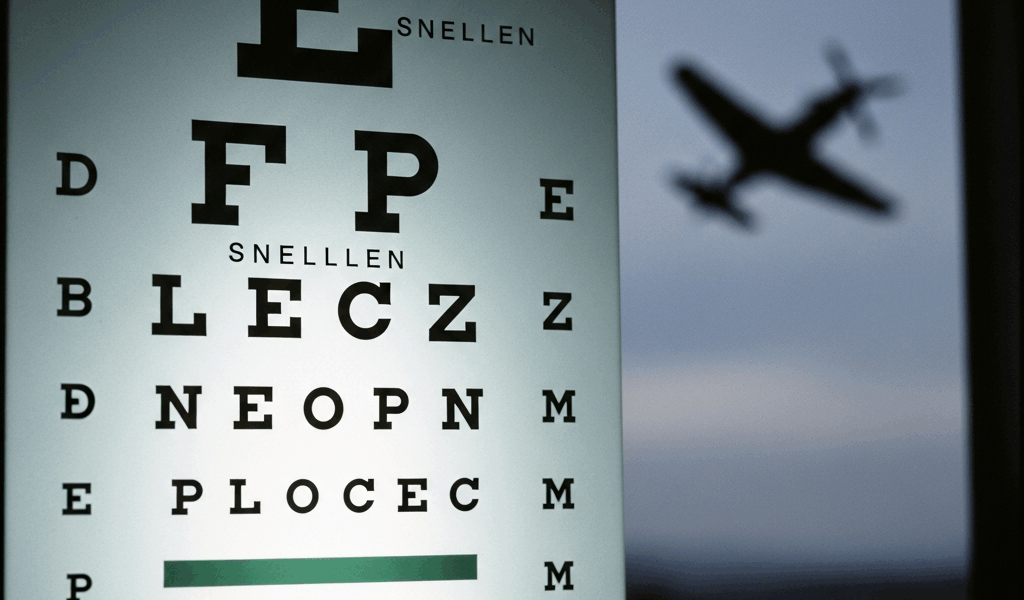
But what is corrected 20/20 in practice? In essence, it’s putting on your glasses or inserting your contacts and reading the 20/20 line on a standard Snellen chart from 20 feet away, with no more than one or two errors per line. But it’s much more than that — it’s the baseline for functional vision across almost every profession requiring decent eyesight. It’s not some elite athletic threshold. It’s normal.
I’ve heard people repeat this myth — thick glasses disqualify you. They don’t. Never have. I’m apparently a -4.50 diopter person in each eye, and my prescription works for me while thinner prescriptions never seemed to generate any aviation advantage for their owners either. Prescription strength is irrelevant to the Air Force. What matters is the corrected result. A candidate wearing -4.50 diopters who corrects to 20/20 is functionally identical to someone wearing -1.00 who also corrects to 20/20. Don’t make my mistake of spending months worrying about a number that doesn’t appear anywhere in the actual regulation.
Vision stability is another concern I’ve seen surface repeatedly. If your prescription keeps shifting and you’re getting new glasses every year — does that disqualify you? Not automatically. But stability does factor into the flight surgeon’s assessment. Significant prescription shifts within the past 12 months should be disclosed. They’ll document it and weigh it against your overall suitability. Mention it early rather than hoping nobody asks.
LASIK and PRK for Military Pilots — What Is Allowed
LASIK and PRK are both approved by Air Force aviation medicine. That single fact changes the calculus for thousands of candidates who assume surgery closes the door permanently.
Here are the specifics:
- Procedure approval: LASIK and PRK both meet standards. PRK tends to be the preferred option for military aviation — it avoids the corneal flap created during LASIK, which matters in high-G environments where long-term complication risks become a real consideration.
- Waiting period: Twelve months post-surgery minimum before applying for pilot training. Vision must be stable and fully healed — not trending stable. Actually stable.
- Pre-op requirements: Many flight surgeons want to evaluate your eyes before you schedule surgery. Some units actively recommend surgeons who have military aviation experience specifically. Worth asking.
- Post-op documentation: Bring your full surgical records and post-op refraction report to your flight physical. The flight surgeon will review healing progression across your documented visits.
Frustrated by the 12-month wait? I get it — but sitting with that frustration for a year beats the alternative. Corneal haze and regression appear most frequently during that first post-op year. Waiting ensures your vision is genuinely stable before you’re responsible for a jet worth $50 million and the people riding in the back.
RK — radial keratotomy — is disqualifying. It’s an older procedure, rarely performed now, but worth knowing if you’ve been researching your own surgical history or if you had work done more than a decade ago.
One more detail: monovision correction — where one eye handles distance and the other handles near vision — requires individual flight surgeon evaluation before approval. It works for some pilots. It isn’t automatically accepted across the board.
How to Get a Vision Waiver if You Fall Outside Standards
This is where the conversation shifts from “do I qualify?” to “what are my actual options?” — which is honestly the more useful question.
Waivers exist. They get granted regularly. This isn’t a sympathetic gesture or bureaucratic theater performed for morale purposes. The Air Force grants waivers when an applicant’s overall qualifications justify the exception. A near-perfect AFOQT score paired with a strong GPA and documented leadership experience can offset vision sitting slightly outside standard limits. The package matters — not just a single data point.
Here’s how the waiver process actually works:
- Initial screening: Your recruiter or officer selection officer evaluates your complete package — test scores, GPA, leadership history, medical background — not vision in isolation.
- Flight surgeon referral: Marginal but potentially waiverable vision triggers a referral to a flight surgeon for detailed evaluation. They assess whether the specific deficiency represents a genuine safety risk or something manageable within operational constraints.
- Waiver request: The flight surgeon or medical authority submits a formal waiver request through AETC channels — Air Education and Training Command. The request documents the deficiency, explains why the candidate can still safely perform the job, and cites applicable precedent.
- Approval or denial: A medical review board or command authority issues the final decision. Approval isn’t guaranteed. But it’s possible — and it happens more often than candidates assume going in.
Color blindness is one example where waivers occasionally move forward for RPA pilot tracks — but rarely for fighter pilots, where instrument color interpretation carries genuine operational weight. Red-green color blindness affecting less than 25 percent of Ishihara plate test results has been waived for specialized roles. That 25 percent threshold isn’t published broadly, which is exactly why early conversations with a flight surgeon matter.
What you should do right now: Contact a recruiter or flight surgeon early. Not deep into your application — early. A single phone call can tell you whether your vision represents a minor footnote or a genuine obstacle requiring a strategy. You’ll get a direct answer and a realistic roadmap. Don’t make the mistake of guessing when the people who actually make these decisions are reachable.

Leave a Reply