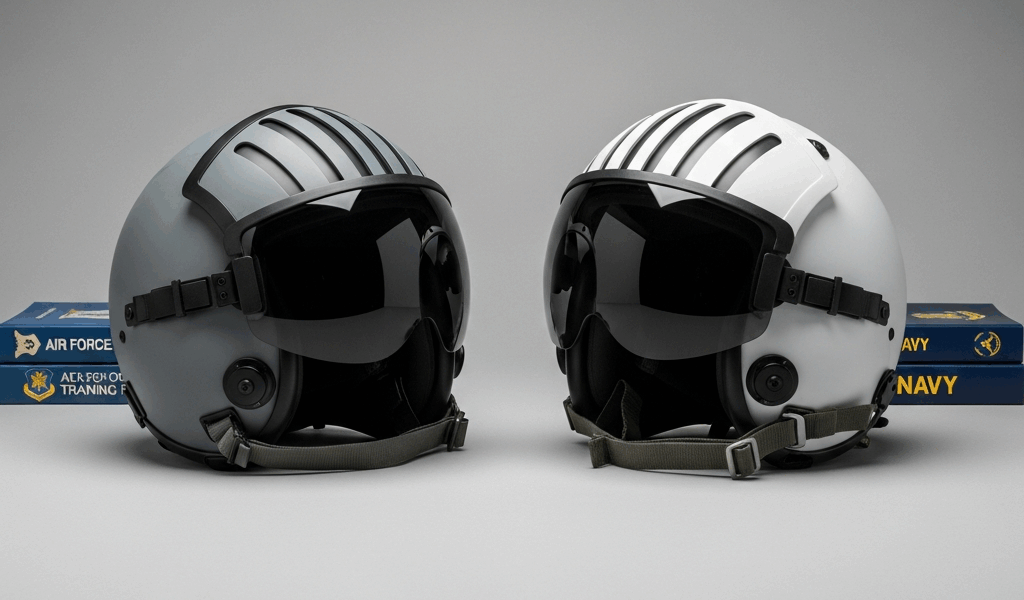
Air Force vs Navy Pilot Training — Key Differences
Air force vs navy pilot training is one of those debates that sounds simple until you’ve actually lived inside both pipelines. I went through Navy flight training at NAS Pensacola and NAS Kingsville, and I’ve spent years comparing notes with Air Force guys at joint bases, during deployments, and at the bar after exercises where we probably got more honest than we should have. The differences are real, they’re significant, and most of what you’ll read online gets them wrong — usually because the writer has never sat in a cockpit wearing either branch’s wings.
Let me fix that.
Primary Training — T-6 Texan II for Both
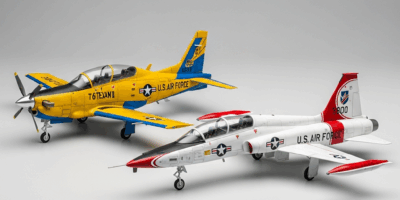
Here’s the thing that surprises most people: for the first chunk of your training, you and your Air Force counterpart are flying the exact same aircraft. The Beechcraft T-6A Texan II — a turboprop single-engine trainer that costs roughly $4.7 million per airframe — is the primary trainer for both the Air Force and the Navy. Same PT6A-68 engine. Same glass cockpit. Same 1,100 shaft horsepower that will absolutely humble you the first time you depart coordinated in a power-on stall.
The bases differ. Air Force primary training runs mostly through Columbus AFB in Mississippi and Vance AFB in Oklahoma. Navy and Marine students go through NAS Whiting Field in Milton, Florida, which sits about 20 miles northeast of Pensacola. The curriculum runs close to 86.6 flight hours in the T-6 for both branches, though the Navy syllabus leans slightly heavier on instrument work earlier in the pipeline. I remember grinding through the contact phase at Whiting thinking I was doing fine, then watching my instrument scores crater the moment we transitioned to the hood work. Lesson learned: don’t sandbag your instrument prep just because the visual flying feels comfortable.
Track select is where the pipelines diverge hard. After primary, students in both branches get sorted into jets, props (multi-engine), or helicopters based on their grades, class rank, and billet availability. The Navy adds a fourth track — the E-2/C-2 pipeline — that goes directly to carrier-based fixed-wing without a dedicated jet track. Air Force track select feeds into Specialized Undergraduate Pilot Training, or SUPT. Navy track select feeds into Advanced Training Command.
The politics of track select are real in both branches. In the Navy, your class ranking matters enormously. First-in-class gets first pick, assuming the billets exist. Air Force works similarly through their SUPT ranking process. One thing I wish someone had told me earlier: fleet needs drive billet availability more than your grades do. You can be top of your class and still not get the platform you want if the Navy needs E-2 pilots more than it needs F/A-18 pilots that cycle. That’s not cynicism — that’s just how the machine works.
Fighter Track — T-38 Talon vs T-45 Goshawk
This section is where the real differences start showing up, and where the Navy pipeline earns its reputation for being genuinely harder to complete.
Air Force student pilots selected for the fighter/bomber track transition to the T-38C Talon at bases like Columbus AFB or Sheppard AFB in Wichita Falls, Texas. The T-38 is a supersonic jet trainer — Mach 1.08 capable, two-seat tandem configuration, J85-GE-5 engines. It was designed in the late 1950s and first flew in 1959. That’s not a typo. The airframe is old, the systems are dated, and it has real limitations. The T-38 doesn’t have an aircraft carrier. It has no hook. It teaches formation, instruments, and advanced airmanship, but it operates exclusively from land bases with long, forgiving runways. You graduate T-38 having flown a fast jet but never having done anything that will kill you if you’re off by three feet on a single pass.
The Navy fighter track goes through the T-45C Goshawk, a carrier-capable trainer derived from the British Aerospace Hawk. NAS Meridian in Mississippi and NAS Kingsville in Texas are the two advanced jet training bases. The T-45C has a max speed around Mach 0.88 — slower than the T-38 — but what it has that the T-38 doesn’t is a tailhook, a carrier-compatible landing gear system, and the full carrier qualification syllabus.
Carrier qualification, or CQ, is legitimately the most stressful training event in military aviation outside of combat. You take your final field carrier landing practice grades at the airfield — hitting a 50-foot wide by 200-foot long box painted on the runway — and then you go to the boat. At Kingsville we drove to Corpus Christi, loaded buses to NAS Corpus Christi, and flew out to the carrier operating in the Gulf of Mexico. You need six day traps and two night traps to earn your wings in the Navy. Night traps on your first carrier qualification event. The Air Force has no equivalent requirement. Period.
Washout rates reflect this. The Navy Advanced Training Command jet pipeline has historically washed out between 20 and 30 percent of students who enter it, depending on the year and fleet demand. Air Force T-38 washout rates run lower, typically in the 10 to 15 percent range for students who make it to that phase. Neither number is soft. But the delta is real, and carrier qualification is the single biggest driver of that gap.
Frustrated by misleading online statistics I found during my own research, I ended up cross-referencing NASC historical graduation data with what pilots I knew personally had actually experienced in their training years. The picture that emerged was that both pipelines are legitimately hard — but the Navy puts a specific, identifiable, life-or-death skill check in the middle of your training that the Air Force does not.
Deployment and Lifestyle Differences
Probably should have opened with this section, honestly, because for most people deciding between branches, day-to-day life matters more than training pipeline details. Let me be direct about what each path actually looks like once you have wings.
Air Force fighter pilots deploy to forward operating bases. Think Al Dhafra Air Base in the UAE, Incirlik in Turkey, Al Udeid in Qatar. You live in a containerized housing unit or, if you’re lucky, a room in a permanent building on base. You fly your missions. You eat in a DFAC. You go to the gym. You call home when the comm lines aren’t jammed. Temporary Duty, or TDY, is the mechanism — you leave your home base, deploy for 60 to 120 days typically, then come back. Your car is in the parking lot. Your family is at the base housing in Tucson or Langley or wherever. The separation is real but the homecoming is reliable.
Navy carrier aviation is a different universe. You deploy on the ship. A standard carrier deployment runs six to eight months. You’re not coming home early because you want to. The carrier goes where it goes, and you go with it. Port calls — stops in places like Bahrain, Crete, Jebel Ali, Busan — are how you see the world and how you stay sane. They’re also genuinely incredible. I’ve walked through the medina in Bahrain at 0200, eaten the best fish of my life in a restaurant in Palma de Mallorca, and watched sunrise over the Strait of Hormuz from the flight deck of a Nimitz-class carrier. You will not do those things on a TDY rotation to Al Udeid.
The tradeoff is real though. Carrier life is cramped. Your stateroom on a nuclear carrier might be shared with two or three other officers. Staterooms run roughly 150 to 200 square feet for a three-person room. The noise never stops. The ship runs a 24-hour cycle and you feel it at 0300 when the flight deck above you sounds like a car crash every 45 seconds during night ops. Your personal space, your privacy, your ability to exercise any individual routine — these things take hits they don’t take on an Air Force base deployment.
Base life between deployments also differs significantly. Air Force bases tend to be more stable, more suburban in feel. Langley AFB in Hampton, Virginia; Luke AFB in Glendale, Arizona; Eglin in Fort Walton Beach, Florida — these are large, well-resourced installations with good family support infrastructure. Navy installations like NAS Oceana in Virginia Beach or NAS Lemoore in the Central Valley of California are also solid, but the operational tempo around carrier air wings means your schedule is less predictable. Work-ups before deployment start months out and the rhythm doesn’t really respect evenings or weekends in the same way.
The Verdict — Which Branch for Your Goals
There is no universally correct answer here. But there is a correct answer for your specific set of priorities, and I’ll give you a clear framework rather than the vague “it depends” non-answer that fills most of these comparisons.
Choose the Air Force if stability is your primary variable. If you have a family, or plan to start one early in your career, or if you value being able to build a consistent home life between deployments, the Air Force structure serves that priority better. TDY cycles are more predictable. Base life is more suburban and settled. The T-38 pipeline is rigorous but the overall training attrition risk is lower. You will fly fast jets and you will see combat zones — but you’ll have more control over your personal life than your Navy counterpart flying off a carrier.
Choose the Navy if you want the deepest possible flying experience and you’re willing to pay for it in lifestyle costs. Carrier aviation is the hardest conventional flying in the world. There is nothing in commercial aviation, in the Air Force, or anywhere else that replicates the skill set built by flying approaches to a moving 1,092-foot runway at night in the Gulf of Oman. If you want to push the ceiling of what a pilot can do — and if you want to travel in a way that no other military job provides — the Navy pipeline and carrier life deliver that. The price is months-long deployments, cramped shipboard living, and a training pipeline that will cut you if you’re not ready.
One thing both branches share that rarely gets mentioned: the people. The pilots I’ve known in both the Air Force and the Navy are, without exception, people who chose this life deliberately and take it seriously. The culture differs — Air Force guys sometimes call Navy guys unnecessarily dramatic about the carrier thing; Navy guys sometimes accuse the Air Force of having it too easy — but the commitment level is identical. Pick the branch whose life fits yours, not the one with the better recruiting poster.
The T-6 hours are the same. After that, everything diverges. Know which divergence you’re signing up for before you raise your right hand.


Leave a Reply