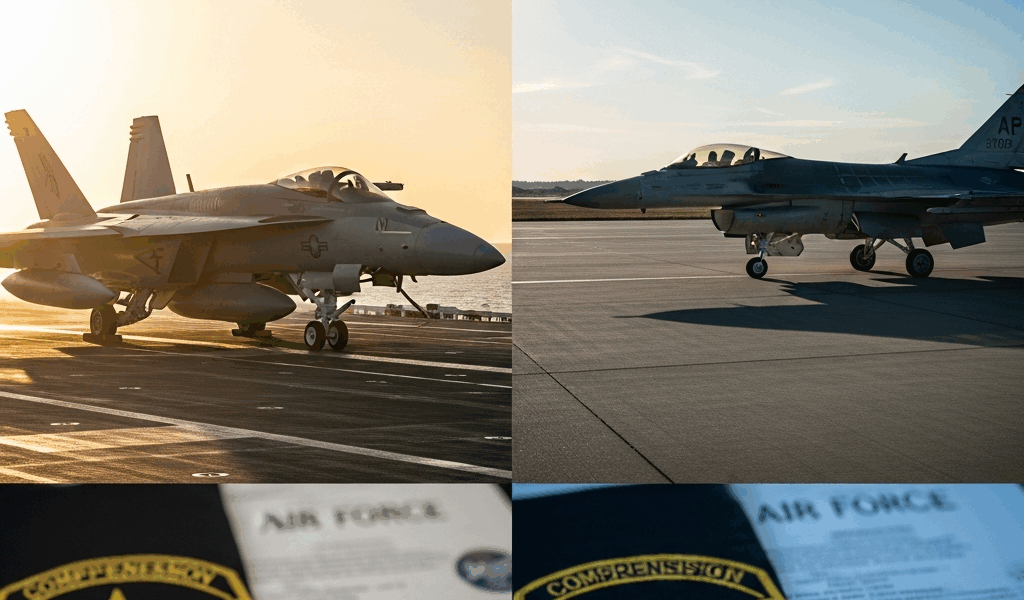
Base Pay Is the Same — Here Is Where It Gets Interesting
Navy vs Air Force fighter pilot pay has gotten complicated with all the half-researched forum posts and outdated pay charts flying around. As someone who flew alongside pilots from both branches during joint exercises, I learned everything there is to know about how these compensation packages actually stack up. Today, I will share it all with you.
Want your own numbers? Run them through our free Military Pilot Pay Calculator — 2026 pay tables, flight pay, BAH and BAS, Navy vs Air Force side by side.
Here is the first thing to get straight: base pay is federally standardized. An O-3 with four years in earns the same base whether he is wrestling an F/A-18 off a carrier deck at 0200 or running an F-16 sortie out of Aviano. The 2024 military pay tables put that number at roughly $5,273 per month. Same rank, same time in service — identical base pay. Full stop.
So why does this comparison even matter? Base pay is maybe 60 percent of what a fighter pilot actually takes home. The rest lives in flight pay structures, retention bonuses, housing allowances, and deployment incentives — and those are where the two branches genuinely diverge. That divergence is worth real money across a ten-year career. Most articles on this topic never get past the pay table. This one will.
Flight Pay and Aviation Continuation Pay Breakdown
Aviator Career Incentive Pay
Both Navy and Air Force pilots receive Aviator Career Incentive Pay — ACIP. But what is ACIP? In essence, it’s statutory pay tied to years of aviation service, not rank. But it’s much more than a simple monthly bonus. It starts at $125 per month in year one and scales up to $840 per month at the 14-year mark. Both branches follow the identical ACIP schedule. A pilot at 12 years pulls $650 per month regardless of uniform color. No difference there.
Aviation Continuation Pay — Where the Branches Split
Probably should have opened with this section, honestly. Aviation Continuation Pay — ACP — is the retention bonus designed to keep trained fighter pilots from walking out the door at year eight and going straight to Delta. Both branches offer it. The terms are not the same.
The Air Force ACP for fiscal year 2024 offers up to $35,000 annually for pilots signing a multi-year agreement — typically five years. That is a potential $175,000 commitment payout over the contract period, paid out annually. The Navy’s ACP structure has historically been more variable. Recent Navy ACP contracts have ranged from $25,000 to $35,000 per year depending on community, with fighter and strike fighter pilots sitting at the higher end of that band.
The honest trade-off pilots talked about in every debrief room I sat in: the Air Force ACP has been more consistently funded and more predictable. The Navy has occasionally sweetened the pot for specific communities — particularly when carrier aviation retention took a hit. I watched guys sign Navy ACP contracts expecting one number and then watch the following year’s cohort get a higher offer. That stings in a very specific way. Don’t make my mistake of assuming last year’s numbers carry forward.
Service commitment attached to ACP is roughly comparable across both branches — typically one year of commitment for each year of bonus received, served beyond any existing obligation. Read the fine print before you sign. Both branches require this, and the language matters.
Allowances, Deployment Pay, and the Full Picture
BAH and BAS
Basic Allowance for Housing is the one that moves the needle most dramatically — at least if you are assigned somewhere with a brutal cost-of-living index. A fighter pilot at NAS Oceana in Virginia Beach pulls different BAH than one at Langley Air Force Base twenty minutes north, but both are sitting in the same expensive Virginia coastal market. An Air Force pilot at Luke AFB outside Phoenix? Cheaper housing market entirely. This is not a Navy versus Air Force issue. It is a geography issue. Basic Allowance for Subsistence runs about $311 per month for officers and is identical across both branches.
Deployment Pay and Carrier Life
Here is where lifestyle and compensation get genuinely tangled. Navy fighter pilots deploy on carriers. A typical carrier deployment runs seven to nine months — sometimes longer when things get complicated. During that time, a pilot in a designated combat zone qualifies for Hostile Fire Pay at $225 per month and, far more meaningfully, tax exclusion on all income earned in the combat zone. On a $10,000-plus monthly compensation package, that tax exclusion is worth real money. Potentially $2,000 to $3,000 in saved federal taxes per month depending on total income. That adds up fast across a nine-month cruise.
Air Force fighter pilots deploy too — Bagram, Al Udeid, Spangdahlem are not vacation postings. But the deployment pattern typically runs four to six months, then home. The carrier pipeline means Navy pilots are sometimes gone nine months, back for three, and immediately entering the work-up cycle for the next one. More combat zone tax exclusion time on paper. Lower quality of life in practice. That’s what makes the tax exclusion math endearing to us finance-obsessed pilot types — it partially compensates for an exhausting operational tempo. Partially.
Career Timeline and How It Affects Lifetime Earnings
Frustrated by the math on ACP commitments versus airline starting salaries — which cleared $100,000 for first-year captains at some regionals after 2021 — a lot of mid-career military pilots started running spreadsheets at their kitchen tables. That math looks different depending on your branch pipeline.
A Navy fighter pilot typically spends more cumulative time at sea and more time grinding through the work-up cycle — that six-to-eight month pre-deployment training block before you even leave the continent. This compresses the window when a Navy pilot can realistically separate and flow to the airlines without leaving bonus money on the table or torching relationships on the way out. An Air Force pilot on a fighter assignment at a stateside base often has slightly more schedule predictability. Timing an airline application around an ACP contract end date becomes a more manageable puzzle.
Promotion timelines run roughly comparable to O-5. The Air Force has historically had a cleaner path to O-6 for pilots who stay operational, though. The Navy’s up-or-out culture is aggressive — passed over twice for O-5 and you are out. That clock starts earlier than most junior pilots expect. I’m apparently someone who watched more than one genuinely talented Navy pilot miss that gate, and the financial hit is severe. Missing 20-year retirement — 50 percent of base pay for life — because of a promotion board timing issue is an expensive outcome nobody briefs you on at commissioning. Don’t make my mistake of assuming the system will reward competence alone.
Which Branch Pays More — The Honest Answer
Same scenario: O-4, ten years of service, one Navy, one Air Force, both on ACP contracts, both at mid-cost-of-living duty stations. Over that ten-year window, total compensation lands close — within $15,000 to $20,000 in either direction depending on deployment timing and how many combat zone tax-free months each pilot accumulated. The Air Force pilot probably has more predictable take-home month to month. The Navy pilot may have edged ahead in tax-free earnings, or may have hit a better ACP year. Neither answer is wrong.
What actually separates them at year ten is not the paycheck — it is the career decision sitting in front of them. The Air Force pilot often has a cleaner runway to either a 20-year retirement or a well-timed airline transition. The Navy pilot may be carrying more sea time, a tighter decision window, and a promotion board timeline that does not care about his logbook hours.
So, without further ado, let’s be direct: if you are still in the decision phase between branches, the pay tables alone will not make the choice for you. The pilot training pipeline breakdown and the military-to-airline transition guide elsewhere on this site will give you a clearer picture of where each branch actually takes you — after the flight suit comes off and the real math begins.


Leave a Reply