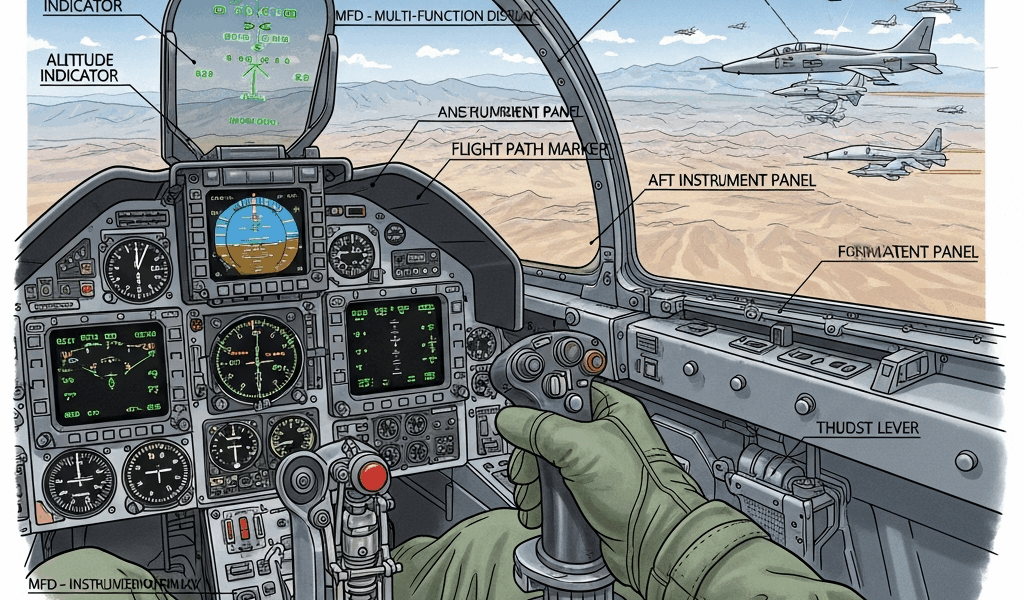
Where T-38 Training Fits in the UPT Pipeline
T-38 Talon training has gotten complicated with all the mythology flying around. Ask ten fighter pilots what the experience was really like and you’ll get ten different answers — all of them accurate, none of them complete. So let me just walk you through the whole thing.
First, the obvious part that often gets skipped: the T-38 isn’t your first jet. That’s the T-6A Texan II. You’ll log roughly 60 hours in the T-6 before you ever touch a Talon cockpit — learning to actually think like a military aviator rather than just point an airplane at the sky. The T-6 flies at 190 knots. The T-38 cruises at 420. That gap is not subtle.
The pipeline works like this. You finish primary training, pass your checkride, and then sit in some aggressively air-conditioned waiting room at your UPT base while assignments get read aloud. Bomber candidates and fighter track students get T-38s. Airlift and tanker folks peel off toward the KC-135 or C-17. If you’re still in the room, you’re either grinning or quietly spiraling. Selection happens at Sheppard Air Force Base in Texas or Columbus Air Force Base in Mississippi. The transition between platforms is brutal — deliberately so. Everything moves faster, the jet responds in ways the T-6 never did, and the margin for error shrinks to something genuinely hard to see.
The T-38 Syllabus Broken Down by Phase
Contact and Basic Handling
Your first T-38 sortie is humbling. That’s not a warning — it’s a guarantee. You’re strapped into a $3.5 million aircraft that first flew in 1966, taxiing on nosewheel steering that feels like pushing a grocery cart with a bent wheel across a parking lot. The 10,000-foot runway disappears faster than your brain is ready for.
Contact phase runs roughly 12 sorties. The content sounds manageable: climbs, descents, turns, recovery from unusual attitudes. Basic airwork. It isn’t manageable, though — not at first. The T-38 carries 5,200 pounds of thrust across two J85 engines and it genuinely wants to fly. You don’t fly the T-38. The T-38 tolerates your inputs. Occasionally it rewards you when you stop wrestling with it.
Your instructor grades five things every second you’re airborne: control inputs, instrument crosscheck, energy management, situational awareness, and whether you’re about to kill both of you. The contact check at the end — a standardized evaluation flown by a pilot who has long since forgotten what it feels like to be afraid — determines whether you move forward.
Instruments
Once you’ve demonstrated you can fly straight and level without accidentally entering a spin, instruments phase begins. Fourteen sorties minimum. You’re under the hood in actual or simulated instrument conditions, navigating entirely by the gauges in front of you — holds, approaches, step-downs, all of it without looking outside.
This is where the surgical pilots separate from everyone else. Your scan — the specific order your eyes move across the instrument panel — becomes a rhythm you either develop or don’t. Airspeed. Attitude. Altitude. Rate. Deviate from it and the airplane deviates from straight and level. Your hands and feet start chasing your instruments instead of leading them. Most students who wash out do so here. Not because they can’t fly — because they can’t fly and manage information simultaneously under real pressure.
The instrument checkride is legitimately hard. You’ll fly an actual instrument approach in real weather if conditions allow, simulated if they don’t. Mid-approach, the evaluator introduces emergencies — engine failure, radio loss, instrument malfunction. You fix them. You don’t get to pause. You don’t get to collect yourself. You fix them while the approach continues.
Formation
Formation flying is where T-38 training becomes something closer to tribal. You’re no longer a solo pilot with a vague fighter ambition. You’re part of a two-ship, then a four-ship, and eventually a formation that banks and climbs like one organism running on four separate brains.
Formation phase covers 18 sorties. You start in close formation — wingtip to canopy, roughly 10 feet of separation. Your lead flies the mission. You fly your lead’s airplane, essentially. You match his pitch, bank, and power inputs exactly. The scan is completely different from everything you’ve built until now. You’re not watching your instruments. You’re watching your lead’s flight control surfaces, the position of his canopy, the horizon behind him.
Then comes tactical formation. Extended trail, combat spread, line abreast. You’re 1,000 feet back or to the side, scanning the sky for threats, preparing to support or defend. The mental load increases sharply — you’re flying the jet, holding formation, scanning for traffic, and running tactical maneuvers while tracking fuel and energy state simultaneously. It’s a lot. That’s the point.
Advanced Handling and the Final Push
Advanced handling phase is the polishing stone — and the grindstone. Combat maneuvering starts here. You’re not flying formation anymore. You’re flying against it. Offensive and defensive moves: the Thach Weave, the barrel roll, lag pursuit, lead pursuit. Every maneuver assumes you’re either hunting your lead’s six o’clock or keeping him from getting yours.
Simulator time becomes genuinely invaluable at this stage. Before you step to the jet, you’ve already flown these scenarios 30 times in the motion-based T-38 FTD on your base — a $2 million box on the ground where mistakes don’t cost anything except ego. You’ve already made the errors. You know what inputs produce what results. That matters more than most students expect it to.
The final checkride — the Advanced Handling Check, or ACH — gets flown against an evaluation pilot who has probably ended 50 student careers in the last three years alone. He knows your playbook. You’ll manage fuel, altitude, and energy while defending against closure rates and angles that require decisions faster than conscious thought. It’s the hardest thing you’ve done in a cockpit. At least until IFF.
What Trips Up Students in T-38 Training
Probably should have opened with this section, honestly. The wash-out rate for T-38 training hovers around 15 percent. Not an abstraction — that’s 15 actual pilots per 100 who walk into the squadron and don’t walk out as combat aviators. Here’s what gets them.
Energy Management Blindness
The single most common failure point is energy mismanagement. Energy in fighter aviation is everything — the combination of altitude and airspeed that keeps you alive and effective. Burn it wrong and you’re the slow guy in a dogfight. Or you’re landing 2,000 feet short of the runway because you didn’t account for descent rate against remaining distance.
Students see the runway. The brain says descend. They pull power to idle and pitch down. The T-38 isn’t a Cessna 172 — you don’t descend without consequence. You’re trading altitude for airspeed, or losing both if you’re not careful. Instructors watch for the exact moment a student stops planning and starts reacting. That’s the thread coming loose. Historically, that’s also when pilots die.
Instrument Scan Breakdown Under Pressure
When an evaluator fails an engine mid-approach, student eyes lock onto the dead engine gauge. The rest of the instrument panel disappears from the scan. Airspeed drifts. Attitude wanders. The student doesn’t catch it — he’s staring at something that no longer matters. The evaluator reaches over and taps him on the headset. Checkride over.
Don’t make my mistake — I froze on a simulated hydraulic failure during a practice approach and lost 200 feet of altitude before my instructor even said anything. He didn’t need to say much after that. The lesson landed.
Formation Discipline
Close formation requires ruthless, continuous attention to the lead’s control inputs. Lag your response by a quarter-second and you’re suddenly 15 feet too far back. Overcorrect too aggressively and you’re occupying airspace that belongs to the lead. Instructors watch for students who let discipline slip when fuel gets low, oxygen equipment acts up, or fatigue sets in.
The failure usually isn’t a single moment. It’s a slow drift across three sorties — standards sliding 2 percent per flight, quietly, until you’re not flying tight formation anymore. You’re flying sloppy formation. The checkride arrives on day four. The evaluator doesn’t grade the drift. He grades where you ended up.
Formation Flying and Why It Defines Your Performance
Formation flying separates T-38 training from every other challenge a pilot faces before it. Nothing in civilian aviation teaches you to merge your awareness with another pilot’s control inputs and make two separate airplanes behave like one.
Close formation is almost pure in its demands. Your lead crosses the airfield in a steep left turn, 45 degrees of bank. You bank 45 degrees at the exact moment he does. He rolls out — you roll out. He climbs at 500 feet per minute — you climb at 500 feet per minute. Separation stays constant. The geometric relationship between your canopy and his doesn’t change.
Grading comes down to three things: position, smoothness, and anticipation. Position means you’re in the correct slot relative to lead. Smoothness means your inputs are gentle enough that lead never feels you struggling. Anticipation — that’s the hard one. It means you’re already moving before he moves, predicting his next input from his pitch attitude and roll rate. You’re not reacting. You’re reading him.
Tactical formation requires a genuinely different part of the brain. Same lead, but you’re 1,000 feet away now. You’re monitoring fuel, scanning for traffic, preparing for a turn toward a simulated target, managing your own energy state and situational awareness simultaneously. The evaluator watches for exactly two things: precise tactical position, and awareness of everything happening around you.
Many students crack under that dual load. They can hold position — but they can’t also scan the sky. They can scan the sky — but they can’t also manage energy. The ones who graduate do both without apparently thinking about either. That “apparently” is doing a lot of work in that sentence. They’re thinking about both. Hard. It just stops looking like effort.
What Completing T-38 Training Actually Means for Your Career
Your T-38 performance record follows you into Fighter Lead-In Training (IFF), advanced fighter training, or bomber lead-in depending on your assigned track. Marginal T-38 numbers mean you don’t pick your first-assignment aircraft — the Air Force picks it for you. Your checkride grades and instructor evaluations determine whether you’re heading to an F-16 with the 8th Fighter Squadron at Kunsan, South Korea, or an F-22 with the 27th Fighter Squadron at Langley, Virginia. That’s not a small distinction.
T-38 training is the gauntlet. You prove you belong or you don’t. Formation grades, energy management in advanced handling, decision-making under pressure — all of it becomes the baseline the rest of your flying career gets measured against.
Worth noting: the T-38 is aging out. The T-7A Red Hawk is replacing the Talon across the UPT pipeline, and most bases should have fully transitioned by 2030. The Red Hawk brings a glass cockpit, a 16,000-pound-thrust engine, and avionics that didn’t exist when the Talon first flew. Training will evolve around that hardware. The fundamentals won’t move, though. Formation flying still demands the same precision it always has. Energy mismanagement still kills pilots who ignore it. The mountain just gets a different shape.

Leave a Reply