“`html
What Spatial Disorientation Actually Is
Military pilot spatial disorientation training methods exist because of one brutal fact: disorientation causes more military aviation accidents than mechanical failure, weather, or pilot error combined. I learned this statistic not from a textbook but from a T-38 instructor who matter-of-factly explained it during my first briefing, then showed me NTSB footage of an F-16 pilot who became convinced he was climbing when he was actually diving at 400 knots toward the ground.
Spatial disorientation happens when your brain receives conflicting signals from three sensory systems simultaneously. Your vestibular system — the inner ear — detects motion. Your visual system sees the horizon and instrument needles. Your proprioceptive system feels G-forces crushing you into your seat. In straight and level flight, these systems agree. In a 4-G turn at night with clouds obscuring the horizon? They argue.
The military experiences this more than civilian pilots for one reason: sustained high-G maneuvers. Commercial pilots rarely exceed 2 Gs. Fighter pilots routinely pull 5, 6, sometimes 9 Gs. At that intensity, your inner ear sends false signals your brain interprets as rolling or pitching when you’re actually stable. Your eyes might catch instrument movement and miss the actual horizon reference. The result is called “the leans” — you feel inverted when you’re perfectly level.
In 2019, the U.S. Air Force documented 23 Class-A mishaps (total loss of aircraft or fatality) directly linked to spatial disorientation. Every single one involved a pilot who had completed standard training. This isn’t about inadequate instruction. It’s about a phenomenon so powerful it defeats instinct. Which is exactly why the training exists.
Ground-Based Simulator Training You’ll Encounter
Before you fly anything, you’ll spend months in rooms designed to disorient you on purpose. This is where the real work happens.
The AGSM trainer — Anti-G Straining Maneuver simulator — looks like a torture device from 1950s spy films. You sit in a seat that tilts in multiple axes while hydraulics apply pressure to your lower body. The pressure starts at 1 G, climbs to 9, drops suddenly back to 1. Your job: read instruments while your inner ear screams that you’re tumbling. The AGSM trainer teaches you that sensation lies. Instruments don’t. By rep 200, your hands move to the airspeed indicator and altimeter before panic takes over.
Motion-based simulators — the F-16 or F-18 pods at bases like Columbus AFB — add visual disorientation. You’re flying a profile on instruments. The simulator tilts. The visual display shows clouds rolling. Your vestibular system insists you’re banking left while your instruments read wings level. The simulator instructor watches your scan pattern. If you stare at one instrument instead of cross-checking three, the scenario gets harder. If you believe your gut and move the stick, you crash digitally. Repeatedly. Probably should have opened with this section, honestly — this is where 60% of spatial disorientation training actually happens.
Instrument-scan drills follow a progression. Week one: clear weather, good visibility, steady altitude. Week three: IMC (instrument meteorological conditions), 3-G turn, read heading while the horizon vanishes. Week six: night formation flight with cloud layers and radio callouts competing for attention. Each scenario targets a specific conflict between systems.
The difficulty ramps deliberately. Your first simulator ride is confidence-building. By month four, instructors introduce g-onset situations — rapid acceleration where your blood pools and you might gray out or black out. You learn to recognize the physical signs: peripheral vision tunneling, blood rushing from your head. You execute an AGSM — tense your leg muscles, strain against your harness, breathe rhythmically. Your G-suit inflates. Pressure returns to your torso and head. Vision clears. You keep flying.
In-Flight Recovery Techniques Instructors Teach
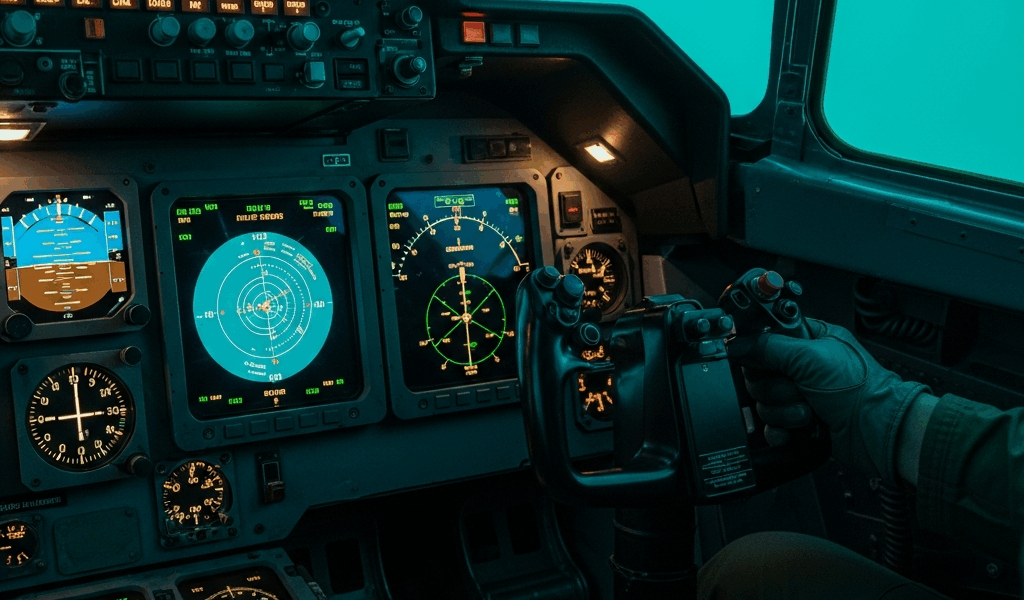
When you’re airborne and disoriented, you have seconds. Trust instruments. Actually trust them. Not the “I’ll look at the altimeter after I fix my attitude” version of trust. The absolute, physical, move-the-stick-to-match-the-needle variety.
Here’s the recovery procedure every military pilot memorizes:
- Reduce thrust to descent power immediately. Disorientation often coincides with a climbing attitude you can’t see. Lower power stops altitude loss.
- Cross-check three instruments: attitude indicator, altimeter, airspeed. Not one. Three. Repeat the cycle every 3 seconds.
- Level the wings on the attitude indicator. Not the horizon. The artificial horizon in your cockpit.
- Adjust pitch to maintain safe airspeed and altitude trend.
- Once stable, execute a climb at safe airspeed back to assigned altitude.
Why does instinct fail? Because your inner ear has been screaming for 10 seconds that you’re inverted. Your eyes caught a glimpse of dark — sky or terrain, you can’t tell. Your muscle memory wants to push forward on the stick to “right” yourself. That kills you. The attitude indicator is programmed, calibrated, and correct. Your gut is terrified and wrong.
Instructors emphasize the tactile component. You physically touch the attitude indicator with your finger while reading it. You verbally call out each instrument: “Attitude indicator — wings level. Altimeter — five thousand and holding. Airspeed — three hundred.” Calling it aloud forces your brain to process the data instead of panic.
Common Disorientation Scenarios in Military Training
The leans appear most often in shallow turns at altitude where visual references are poor. You’re in a 15-degree banked turn, stable, instruments aligned. Your inner ear detects the turn, sends a signal, then stops detecting acceleration — because acceleration has stopped. You’re in a steady turn. Your brain interprets this as motion started, now stopping, equals leveling. You feel yourself rolling upright. You move the stick to level. You’ve just rolled into a 30-degree turn that your instruments show clearly but your body denies.
Somatogravic illusions hit during rapid acceleration on takeoff or during a low-level bombing run. When thrust increases suddenly, your body feels pushed backward. Your brain interprets backward pressure as pitch-up. You’re actually climbing. You feel level. You’re actually nose-high and slowing. This kills more fighter pilots than any other illusion because it happens at low altitude where recovery time is zero.
Coriolis effects emerge in prolonged turns. During a 20-second sustained turn, your inner ear fluid is moving steadily. When you level the wings, that fluid continues moving. Your brain perceives this continued motion as a turn in a different direction. You feel yourself rolling the opposite way. You correct. You spiral. Formation flying during instrument conditions is where this kills pilots — you’re concentrating on wingman position and radio calls, you don’t notice the spiral until the turn coordinator shows it clearly.
Inversion illusions dominate night training. You’re flying level at night with no horizon. Clouds move below you. Your mind interprets clouds below as ground below and sky above equals you’re inverted. You push forward on the stick. You’re actually level, now descending into terrain. Low-level night navigation is taught strictly with instruments precisely because this illusion is that convincing.
How to Prepare Before You Step Into the Cockpit
Spatial disorientation is a trainable skill. Not innate talent. Not something pilots are “naturally good at.” Trainable. This matters because it means you control your outcome.
Study the physiology. Know exactly what your vestibular system does and why it lies under certain conditions. The more you understand the mechanism, the less your brain trusts the sensation. I spent three hours reading the vestibular physiology section of the Air Force’s Spatial Disorientation guide before my first motion-based sim. When the sim tilted and lied to me, I wasn’t confused — I understood exactly what my inner ear was doing wrong.
Physical fitness changes your baseline. Strong leg muscles make AGSM straining more effective. Cardiovascular fitness means you recover faster from G-induced loss of consciousness. Neck strength reduces strain during high-G maneuvering. This isn’t gym theory — it’s mechanical advantage in the cockpit.
Sleep discipline is non-negotiable. Vestibular processing deteriorates with fatigue. A pilot who’s slept 5 hours is twice as susceptible to spatial disorientation as one who’s slept 8. You cannot train around this. You can only respect it.
Practice instrument interpretation until it’s reflex. In the sim, before you face disorientation scenarios, you should be able to read the attitude indicator without thinking. Your eyes should move from altitude to airspeed to heading and back in a pattern so automatic you could execute it while reciting the phonetic alphabet.
Visualize recovery procedures. Lying in your bunk the night before a training sortie, walk through the cross-check sequence in your mind. Attitude, altitude, airspeed. Attitude, altitude, airspeed. When you’re actually disoriented, your brain will play back the pattern you’ve rehearsed, not the panic it wants to generate.
You will be disoriented in training. Everyone is. The pilots who recover are the ones who trusted their preparation and their instruments. That’s the entire point of these methods.
“`

Leave a Reply