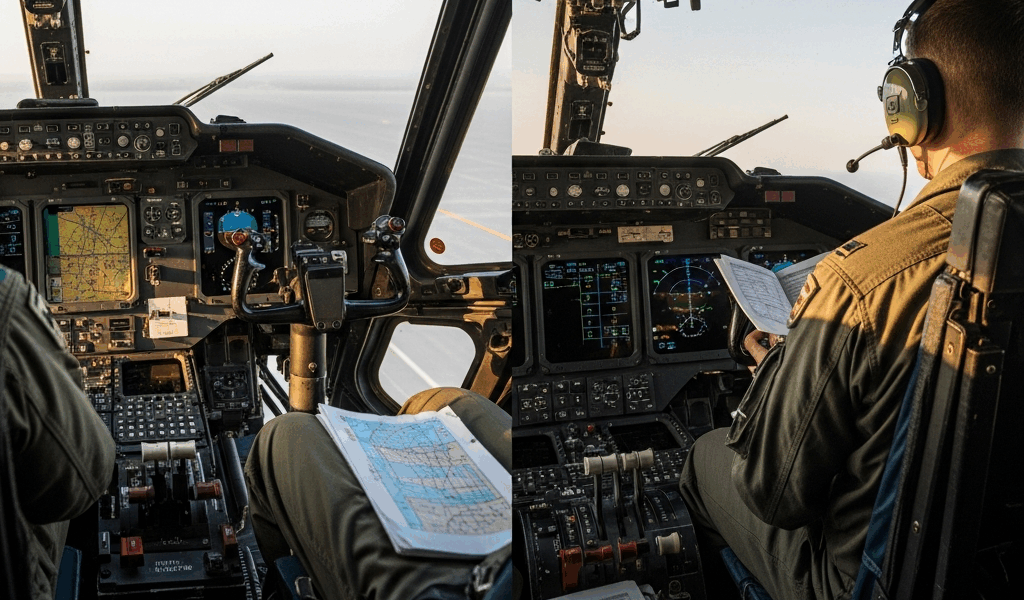
Two Paths Into the Army Cockpit
The army warrant officer pilot vs commissioned pilot question has gotten complicated with all the bad advice and forum noise flying around. As someone who spent months digging through both tracks before making my own decision, I learned everything there is to know about this particular fork in the road. Today, I will share it all with you.
Neither path is objectively better. Full stop. They are built for different people with different priorities — and the honest answer is that getting this wrong costs you years, not months. Both wear wings. Both go to the same flight school. But from the moment training ends, their daily realities split hard.
Training Pipeline Side by Side
Getting to Fort Novosel
Fort Novosel, Alabama — previously Fort Rucker until the 2023 renaming — is where both tracks land for Initial Entry Rotary Wing training. But what is IERW? In essence, it’s the shared flight school experience every Army aviator goes through regardless of rank or commissioning source. But it’s much more than a training course — it’s the last place both paths look identical before diverging permanently.
Warrant Officer Flight Training is the faster lane. No college degree required. Civilians as young as 18 can apply, upper age limit sits at 32 at enlistment. The pipeline runs like this: WOFT application and selection, Basic Combat Training for civilian applicants, Warrant Officer Candidate School — roughly six weeks at Fort Novosel — then straight into IERW. Civilian to cockpit in under 18 months is genuinely realistic if your packet is competitive and training backlogs don’t eat your timeline.
Frustrated by the vague answers on every military forum, I nearly talked myself out of researching WOFT entirely — which would have been a mistake. Acceptance rates hover around 50 percent or lower even for strong packets. It’s selective. Take that seriously.
The commissioned path requires a bachelor’s degree, no exceptions. You earn your commission through ROTC, OCS, or West Point, complete the Officer Basic Course for your branch, then compete for an aviation slot. Aviation is a competitive branch selection — not everyone who wants it gets it. Once you have the slot, you attend IERW alongside warrant candidates. Timeline from college graduation to cockpit regularly stretches past 24 months, sometimes longer depending on branch timing and school availability.
Service commitments differ too. WOFT carries a six-year active duty commitment from flight school graduation. Commissioned aviators typically owe the Army six years from their aviation wings date as well — but commissioned service obligations layered on top, especially if you took specific bonuses or education benefits, can push total obligations further out.
Pay and Promotion Reality Check
The Grade Structure
Probably should have opened with this section, honestly. Pay surprises people more than anything else in this comparison.
Warrant officers run WO1 through CW5. Commissioned aviation officers run O-1 through O-6 and theoretically beyond, though general officer billets for aviators are rare enough that you shouldn’t factor them into your decision-making.
A newly pinned WO1 under two years of service earns roughly $3,694 per month in base pay off 2024 tables. A brand new O-1 pulls approximately $3,637. Nearly identical at the start. The gap opens somewhere between year eight and year twelve.
A CW3 — the rank most warrants hit between 8 and 12 years — earns base pay around $5,800 to $6,700 per month depending on exact time in grade. A Captain at the same service point earns roughly $5,500 to $6,100. Stack Aviation Incentive Pay on top of both — AvIP maxes at $1,000 per month for aviators past 14 years of aviation service, scaling up from $125 per month at entry. Both warrants and commissioned officers receive AvIP while in aviation assignments, so that part washes out.
I’m apparently wired toward accumulating flight hours over everything else, and the warrant math works for me while the commissioned promotion grind never appealed to me the way I thought it would. Don’t make my mistake of assuming the commission is automatically the better financial deal. A CW3 flying UH-60s at Fort Campbell frequently takes home more total compensation than a Captain who has drifted into staff roles and away from aviation currency requirements.
Warrants who stay in the cockpit consistently, hit CW4 and CW5, and stack BAH in a high-cost-of-living area build a genuinely comfortable career. A CW5 with 20-plus years clears over $8,000 per month in base pay alone. The commissioned ceiling is higher — an O-6 Colonel at max longevity clears over $10,000 per month — but reaching O-6 means surviving competitive promotion boards at O-4 and O-5, moving through non-flying staff and command billets, and accepting that cockpit hours drop significantly in the back half of your career.
Career Ceiling and Leadership Roles
This is where the real difference lives. Recruiters tend to soft-pedal it in ways that actively mislead people, so let’s be direct about it.
But what is a warrant officer, really? In essence, it’s a technical expert and primary authority in their specialty — not a consolation prize for someone who didn’t make it into the officer corps. That framing is wrong and outdated. A CW4 or CW5 aviation warrant advises commanders, standardizes training across units, and carries institutional knowledge that commissioned officers cycling through two-to-three-year assignments genuinely cannot replicate. That’s what makes senior warrants indispensable to units that depend on them.
The ceiling is real, though. Warrants do not command battalions. They do not command brigades. General officer is not on the table. If you are someone who reads unit command histories at night, who thinks about leading 800 soldiers through a deployment, who wants to shape doctrine at brigade or division level — the warrant path will frustrate you somewhere around year eight to twelve when commissioned peers start pinning on Major and competing for command. That frustration is real and I’ve watched it happen.
Commissioned aviation officers follow a track that pulls them progressively away from the cockpit. A successful O-4 Major is largely a staff officer flying enough hours to maintain currency. Battalion commanders flying Apache helicopters exist — the command job is the priority, though. The helicopter becomes a tool of the assignment rather than the assignment itself. That’s not a criticism. It’s just what the role requires.
Built for the pilot who genuinely, primarily wants to fly: WOFT. Built for the officer who sees aviation as one chapter in a broader leadership career: the commission. That’s what makes this decision so consequential — both options are right, just for different people.
Which Path Should You Choose
So, without further ado, let’s dive in. Here is a direct framework — answer these honestly before you sign anything.
- Do you want maximum cockpit hours over a career? WOFT.
- No college degree, or no interest in spending four years earning one before you fly? WOFT.
- Do you want to command a battalion or brigade, compete for senior rank, or set yourself up for a post-military career that specifically leverages a commission? Commissioned officer path.
- Degree already in hand, genuinely want the leadership development structure — not just the flying? Commissioned path.
- Are you 23, degree done, uncertain about long-term military ambitions, just want into a helicopter cockpit as fast as possible? WOFT still probably wins on speed and simplicity.
The mistake I made early — and one I hear repeated constantly on aviation forums and in recruiter offices — was treating the commissioned path as the prestige option. It is not a prestige hierarchy. It is a role differentiation. A CW5 Apache instructor pilot with 4,000 hours and a chest full of combat decorations is not below a Lieutenant Colonel who flew 400 hours before moving into operations officer roles. That was 2003 thinking. Different jobs for the Army, full stop.
While you won’t need to map out your entire 20-year career before signing, you will need a handful of honest conversations with people actually doing both jobs. Post-military career flexibility is worth acknowledging here too. A commission — particularly from OCS with a degree already in hand — reads differently to civilian employers than a warrant does. Not because warrants are less capable. Civilian HR departments frequently don’t understand the warrant system and default to treating a commission as the recognizable credential. Federal law enforcement, defense contracting leadership, corporate management tracks — the commission carries structural advantages there that are hard to quantify but genuinely exist.
First, you should download the current WOFT application packet directly from HRC’s aviation branch page — at least if the warrant path is your direction. Confirm your SIFT score eligibility before you build momentum around a timeline. Find a current or former warrant officer in Army aviation willing to review your packet before submission — not a recruiter, an actual aviator who went through the process. If commissioned aviation is the route, contact your nearest ROTC battalion or OCS liaison, confirm aviation is a realistic branch option given your academic record, and request an aviation branch informational call through the Aviation Branch at Fort Novosel directly. Both paths have legitimate entry points. The worst outcome is spending two years chasing the wrong one.



Leave a Reply