“`html
The Fundamental Difference — Approach Profile
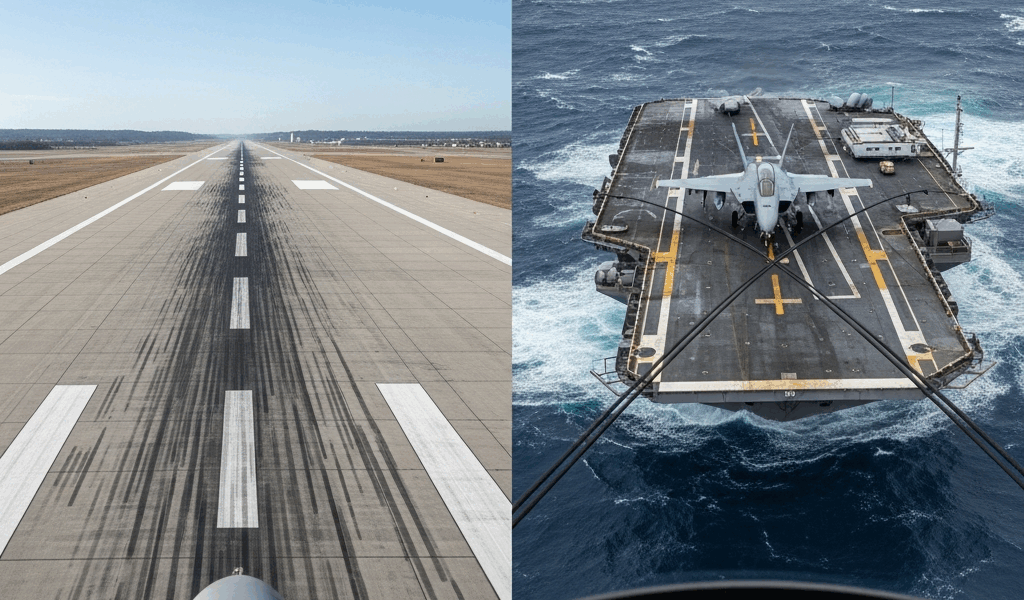
I spent the better part of a decade talking to Navy strike fighter pilots, and honestly, the first thing they’d tell you about carrier landings versus runway approaches is this: you’re not flying the same profile at all. The physics look similar on paper — you descend at an angle, you touch down. But the moment you strap into an F/A-18 headed for a carrier deck, everything changes.
Navy pilots aim for a 3-degree glide slope. Not 2.5 degrees, not 3.5 degrees. Three. From roughly 3.5 miles out, you’re locked onto that angle like it’s painted on your retinas. The reason isn’t arbitrary. A shallower approach means you might land short and hit the ramp. Steeper means you slam into the flight deck hard enough to break the nose gear. Both end your day badly, and neither one gets forgotten.
What keeps you on that slope is the Optical Landing System — “the ball,” as pilots call it. It’s this mirror-based instrument mounted on the left side of the flight deck, and it shows you a row of lights. The meatball in the middle stays green when you’re perfect. Drift above it and you see amber lights. Drop below and it goes red. You’re flying the ball the way an Air Force pilot flies the Instrument Landing System, except ILS gives you a two-mile margin for error. This doesn’t.
Now, Air Force runway approaches use ILS too, but they’re using it completely differently. An F-15 or F-16 pilot descends at whatever angle gets them down safely — usually shallower, around 2.5 to 3 degrees depending on runway length and weather. They’ve got 10,000 to 12,000 feet of concrete. They’re using visual references from the runway itself: the touchdown zone markers, the numbers painted on the asphalt. If the descent looks wrong at 500 feet, there’s a solution you don’t have on a carrier. Push the throttles forward and go around.
Then there’s CASE — Carrier Approach Stabilization Equipment. This system monitors your descent rate, angle, and alignment in real time. Miss the parameters by too much and a warning fires. On a 4,000-foot carrier deck with 24 other aircraft parked on it, that warning means something catastrophic just became possible. An Air Force pilot hears a caution and executes a missed approach to a 2-mile-long runway. A carrier pilot hears that same caution and realizes they have maybe 12 seconds to fix it or they’re getting waved off by the LSO.
Speed Control and Throttle Management Under Pressure
Probably should have opened with this section, honestly. This is where the real difference lives. Runway and carrier landings look identical until you talk about energy management, and that’s when pilots realize they’re learning two completely separate skills.
An Air Force pilot manages speed across the entire approach. You’re at 250 knots five miles out. You’re at 180 knots two miles out. You’re at 140 knots crossing the threshold. The descent rate adjusts as you slow down — smoothly, predictably. If you’re too fast or too slow, you have time to recognize it and correct it. Really messed up? You add power and climb back out. The runway will be there in five minutes.
A carrier pilot cannot do any of that. Speed control on a carrier approach is so aggressive it borders on violent. You’re holding a constant 600 feet per minute descent rate, which sounds gentle until you remember you’re also trimming the aircraft to maintain precisely 1.0G in pitch. Miss that by 0.2G and you’re either climbing or descending faster. The ball moves. You correct. The throttles are moving constantly — not smoothly, but in discrete adjustments of 2 or 3 percent power. It’s almost jerky to watch.
Why? Because there’s no second attempt. You get one shot at landing on that 4-acre piece of moving ocean. Miss the wires — the four arresting cables stretched across the deck — and you’re either boltering or you’re ejecting. The consequence is absolute and irreversible. A Navy pilot’s throttle hand is trained to make micro-adjustments under conditions that would make most people panic.
Here’s the thing that separates them: an Air Force pilot lands the aircraft. A carrier pilot lands the energy state. You’re not trying to touch down perfectly — you’re trying to arrive at the flight deck with precisely the right energy to catch the third or fourth wire. Too much energy and you overshoot. Too little and you won’t hook anything. I watched a carrier pilot describe it as “landing the 25-ton bomb,” because if you screw up the energy calculation, that bomb is landing somewhere it shouldn’t be.
This difference gets trained into your reflexes over hundreds of landings. A carrier pilot’s hands move constantly on the throttles — tiny adjustments, perpetual corrections. An Air Force pilot’s hands adjust power periodically, when the situation calls for it. By the time you’ve logged 500 hours in each community, you’ve built completely different muscle memory around the same control.
Decision-Making Timeline — How Fast You Must React
Bring this up in any conversation about Navy versus Air Force flying, and you’ll hear the same number: eight seconds. That’s the window a carrier pilot has to recognize they’re in an unstable approach and correct it before the air boss decides to wave them off.
An Air Force pilot has 30 to 45 seconds. Maybe more if the runway is long and the weather is good. At 500 feet, if the approach looks ugly, you’re going around. The tower won’t even look twice at it. Safety is built into the system through redundancy and distance.
Eight seconds. From the time an instrument reading goes slightly wrong to the moment the LSO is yelling “WAVE OFF, WAVE OFF, WAVE OFF” into your headset — that’s your window. Most pilots describe it as barely enough time to process what you’re seeing and input a correction. Some describe it as not enough time at all, which tells you something about how tight the margins really are.
This compresses decision-making in a way that’s almost impossible to simulate on the ground. A carrier pilot’s brain is running at a different clock speed than an Air Force pilot’s brain. You’re making the same types of corrections — pitch, roll, power — but you’re making them faster and under higher stakes. One mistake doesn’t cost you a second approach. It costs you a waveoff, which costs you fuel, which costs you the mission, which costs you credibility with your squadron.
The training reflects this reality. Navy pilots practice approaches obsessively — 50 or 60 passes in a single week during carrier qualification. Air Force pilots do carrier-level precision approaches during specific training blocks, not every single flight. The volume matters. Your nervous system either adapts to making decisions in eight-second windows, or it doesn’t.
G-Loading and Physical Demands of Arrested Deceleration
When you catch an arrestor cable at 150 knots and decelerate to zero in four seconds, you’re experiencing approximately 3 to 4 positive Gs of deceleration force. Your 200-pound body weighs 600 to 800 pounds for those four seconds. Your organs shift. Your vision compresses slightly. Your abdominal muscles work harder than they’ve ever worked to keep blood in your head.
A standard runway landing, even a firm one? Maybe 1.5 to 2 Gs on touchdown and rollout. Completely different stress profile.
Navy pilots wear g-suits that inflate during carrier approaches and arrested landings to help manage blood pooling. They undergo specific conditioning for this repeated G exposure. By the time they’re doing ten carrier landings in a single day, their bodies have adapted to handle it. Air Force pilots don’t need this. They experience sustained Gs during combat maneuvers or aggressive instrument approaches, but not the repetitive spike-and-recover pattern of carrier deceleration.
Both are demanding. Both require physical conditioning. But an Air Force pilot spends their physical training on endurance and sustained G tolerance — the kind of stress that builds up over hours. A Navy pilot spends it on explosive deceleration tolerance and repeated high-G events — the kind that spike and recover in seconds. The conditioning is different because the demand is different.
Which Path Fits Your Piloting Style
I’ve never met a bad pilot who chose the wrong service. But I’ve met plenty of pilots who knew which one fit them better.
If you’re someone who thrives in compressed decision windows — someone who can process information rapidly and input corrections under extreme time pressure — Navy flying makes sense. You’ll be taking off and landing the same aircraft 200+ times a year, and every single landing will demand complete focus. The stress is real. The margin for error is real. And for some pilots, that’s exactly the challenge they want.
If you’re someone who prefers measured approaches, who wants to recognize instability and have time to correct it, or who’s comfortable climbing back to altitude to try again — Air Force flying is legitimate. The challenge is different, not lesser. You’re flying longer distances, managing more airspace, executing more complex missions. You’re just not landing on a moving target.
Both produce elite pilots. Both produce commanders. Both require absolute precision. The difference is where that precision gets tested and how fast you have to think.
If you’re in the selection process, actually sit in the right seat for both communities. Actually watch the ball. Actually feel the deceleration. Your instincts will tell you which one you belong in. Listen to them.
“`

Leave a Reply