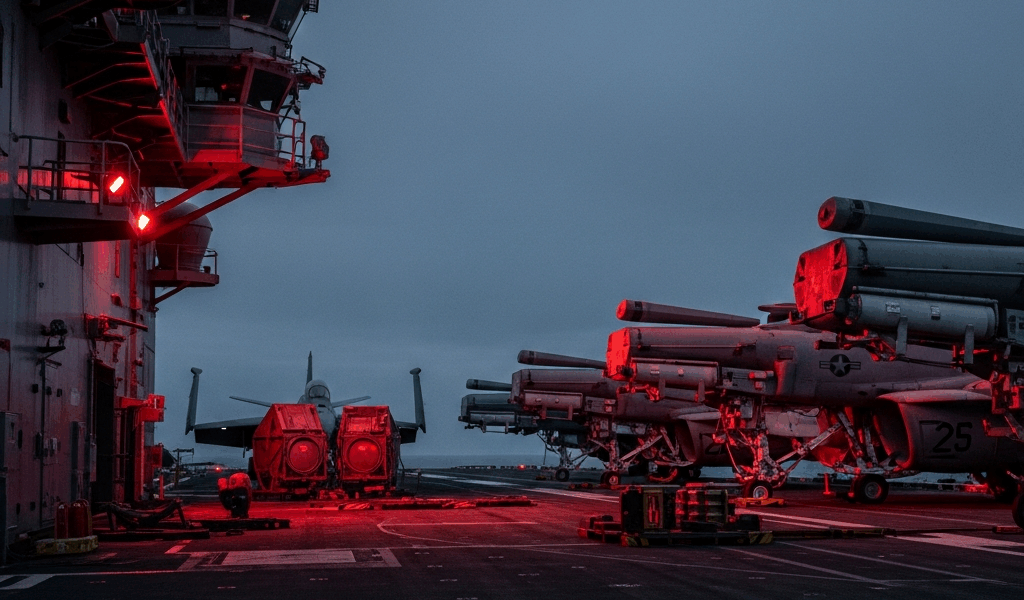
How Military Pilots Improve Night Vision for Carrier Operations
Landing a fighter jet on a pitching aircraft carrier deck at night — genuinely one of the most difficult things a human can do. I’ve spent years researching naval aviation, and I keep circling back to this one fact that won’t go away: night carrier operations strip away every visual safety net pilots build during daylight flying. The techniques military pilots use to adapt their vision — both the biological side and the mental side — aren’t classified, but they’re also not something you pick up in standard flight training. They emerge through deliberate practice, specific protocols, and understanding how the human eye actually behaves when the sun goes down.
Why Night Carrier Landings Are Harder Than Day Operations
Daylight gives a carrier pilot dozens of visual references. The horizon. The ship’s wake cutting through water. Other aircraft holding formation. The groove — that final approach path — shows itself through contrast and shadow. The landing signal officer stands visible on deck. Distance estimation works the way your eyes evolved to handle it.
Darkness takes almost all of it.
Depth perception collapses when contrast and color variation disappear. A pilot might calculate they’re sitting 100 feet above the deck. They’re actually at 40 feet. That margin of error doesn’t exist in carrier aviation. The spatial anchors that define a day approach — the ship’s position relative to clouds, the angle of sunlight bouncing off water — vanish entirely. What’s left: instrument data, a small lit landing area, and peripheral awareness of a 4.5-acre flight surface that’s actively moving beneath them.
Instrument scan fatigue hits faster at night. During daylight, pilots distribute attention between outside references and instruments naturally. At night, they’re locked into instruments — the Heads-Up Display, the altimeter, the glide slope indicator. That constant instrument focus drains the nervous system. Probably should have opened with this section, honestly, because understanding the fatigue piece explains why pilots need to manage their visual capacity before night ops even begin.
The psychological load is real. Pilots report increased stress during night approaches. Some of it is rational — the operational risk runs objectively higher. Some of it is primal. Human vision evolved for daylight. Flying toward a moving ship you can barely see, with zero margin for error, activates something very old in the brain.
The Science of Scotopic Vision Adaptation for Pilots
Your eye contains two types of light-sensitive cells: cones and rods. Cones detect color. They perform brilliantly in daylight. In darkness, they’re useless.
Rods detect motion and light intensity when conditions are dim. They’re so sensitive they can pick up a single photon of light. Here’s the catch: rods don’t cluster in the center of your eye where you focus. They spread across the peripheral retina. This is why a faint star disappears when you stare directly at it, but reappears when you look slightly away. The rods in your peripheral vision grab what your central cones can’t.
Dark adaptation requires time — real time. The biological shift from cone dominance to rod dominance takes 20 to 30 minutes of complete darkness. During that window, your eye’s light sensitivity increases by roughly 100,000 times. Then one bright light shows up — a flashlight, an instrument panel suddenly illuminated — and the clock resets to zero. This is why carrier pilots obsess over red lighting.
Red light exists at the long-wavelength end of the visible spectrum. It barely stimulates cones, which are built for daylight. Rods? Almost completely insensitive to red. A pilot can navigate the ready room, read briefing materials, check instruments — all under red-filtered light — without destroying their dark adaptation. The moment white cockpit lighting turns on, even briefly, the entire dark adaptation clock resets.
This isn’t abstract theory. A pilot who spent 25 minutes building dark adaptation, then glances at an unfiltered light, loses approximately 30 percent of their night vision sensitivity. That’s measurable. That’s actionable. That changes how pre-flight procedures work.
Pre-Flight Techniques to Maximize Night Vision Readiness
Experienced naval aviators show up to the ready room 45 minutes before a night launch. Not universal across all squadrons, but it should be. The goal: begin dark adaptation well before engines fire.
Once inside, all briefing work and navigation happens under red light. Red flashlights. Red-filtered overhead fixtures. Red-lined charts and approach plates. Some squadrons issue headlamps with swappable red lenses — the Petzl NAO+ model fitted with red filters is one civilian equivalent, though naval aviators use military-specific equipment. The principle stays identical: anything emitting light needs to be red-spectrum only.
Diet matters more than pilots typically acknowledge. Vitamin A is the direct precursor to rhodopsin — that light-sensitive protein living inside rod cells. A pilot low on vitamin A will adapt to darkness more slowly and experience reduced night vision sensitivity. This doesn’t mean swallowing vitamin A supplements 30 minutes before launch — that won’t work. It means consistent vitamin A intake across days and weeks. Carrots. Sweet potatoes. Beef liver. Kale. The cliché exists because the science backs it up. A pilot eating carrier chow heavy on processed food and light on fresh vegetables will struggle more with night vision than someone managing their nutritional intake.
Sleep is non-negotiable. Fatigue degrades dark adaptation. An 18-hour awake pilot has noticeably worse night vision than that same pilot after 8 hours of sleep. This is why squadrons schedule night ops around sleep protocols — and why pilots often decline night flying when sleep-deprived. It’s not just alertness. It’s the physiological capacity of the rod-dominated visual system.
Pre-op lighting management extends to what the pilot wears. Some aviators use eye patches over one eye while approaching the ready room. Extreme? Actually standard in certain naval squadrons. The patched eye stays dark-adapted. If cockpit lighting fails or a pilot needs backup night vision capacity, that eye is immediately available at full sensitivity. It takes discipline — flying with reduced depth perception temporarily — but it adds a genuine safety margin.
Caffeine intake matters, though not how most people think. Caffeine doesn’t directly impair night vision. But caffeine preventing sleep destroys the sleep protocol and indirectly damages night vision readiness. Pilots timing night ops typically avoid caffeine 6-8 hours before launch to protect sleep quality.
In-Cockpit Strategies During Night Carrier Operations
Strapping in marks the moment when maintaining night vision becomes primary work. Cockpit lighting is constant negotiation. Instrument panels require illumination. Bright white light destroys dark adaptation in seconds.
Modern fighter cockpits use red or blue-tinted instrument lighting. Blue works almost as well as red because the eye becomes less sensitive to blue wavelengths when rods dominate. A pilot dimming instrument lighting to the minimum readable level is protecting their night vision with every adjustment.
The HUD — the Heads-Up Display — becomes primary reference during night approaches. Instead of scanning multiple instrument gauges, the pilot maintains visual contact with flight data projected directly into the field of view. This cuts scan fatigue. Attention stays focused. The HUD isn’t bright enough to destroy dark adaptation — it’s specifically designed not to be.
Reference point selection changes during night ops. Daylight approaches track dozens of visual landmarks. Night approaches? Maybe three: the ship’s landing lights, the glide slope indicator data on the HUD, and deck lights defining the landing area. Focusing attention this narrowly feels reductive. It’s actually protective — it prevents scan overload and keeps visual attention from wandering into darkness where there’s nothing to see.
Workload management is the actual skill. Night carrier landings demand split-second decisions with incomplete information. A pilot managing workload effectively has cognitive capacity for those decisions. A pilot at maximum load will make errors. This is why experienced naval aviators brief night approaches differently than day approaches — they explicitly discuss decision points, abort criteria, and instrument scan sequences before takeoff.
Training Drills to Build Confidence in Low-Light Conditions
Simulator-based night operations training is where the real learning happens. Handled by a skilled instructor, it becomes virtually indistinguishable from actual night carrier operations. The pilot gets instrument presentation, approach geometry, and psychological stress — without actual risk.
Most squadrons use progressive exposure. New pilots start with simulator night ops at moderate difficulty. Ship pitch and roll are minimal. Wind is stable. Weather is clear. From there, difficulty escalates across multiple flights. Ship motion increases. Wind becomes variable. Weather degrades. By the time a pilot flies their first actual night carrier approach, they’ve completed 15-20 simulator repetitions at increasingly difficult variations.
Mental rehearsal complements simulator training. Pilots spend time before sleep visualizing the approach sequence. Not daydreaming — deliberately imagining specific moments: the lineup during approach, the descent rate, the moment the deck comes into clear focus, the touchdown. This builds neural pathways. When the actual approach happens, those pathways activate. The approach feels familiar. Panic becomes less likely.
Night currency training keeps pilots sharp. Carrier operations demand regular repetition. A pilot who hasn’t done a night approach in 3 months is measurably rustier than a pilot from last week. Squadrons structure training rotations to maintain night currency — typically one night approach every 2-3 weeks during active operations.
The confidence emerging from this training is genuine. A pilot with 100 simulator night approaches and 10 actual night carrier landings has moved night ops from “terrifying” into “difficult but manageable.” That psychological shift is the ultimate goal. The techniques work. The training works. Night vision improves because the pilot’s brain learns to extract more information from available light. That’s how military pilots master one of aviation’s most demanding challenges.

Leave a Reply