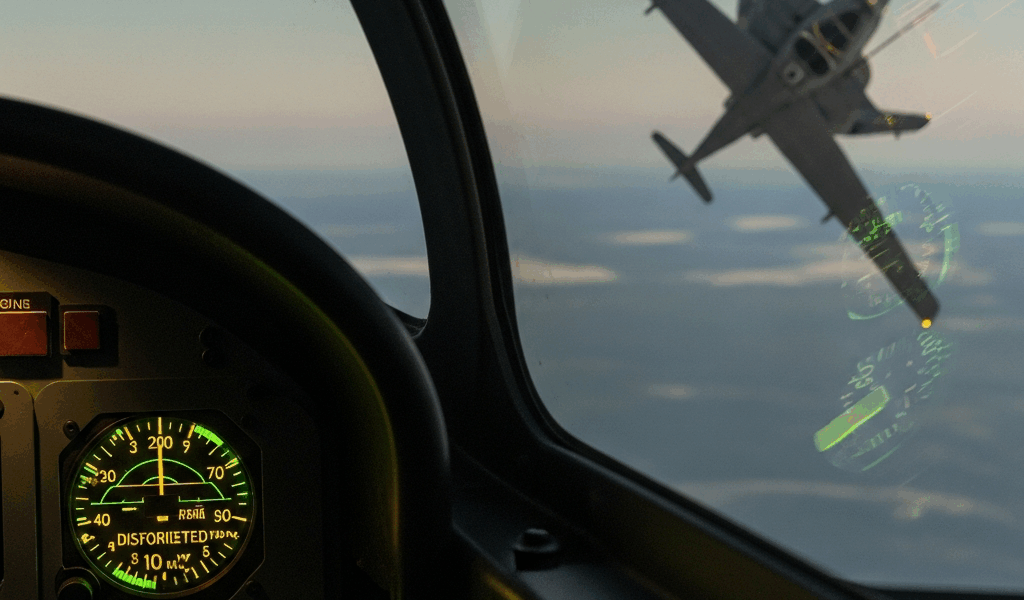
Why Military Pilots Fail the Spatial Orientation Test
I spent six months watching pilot candidates walk out of the aerospace medicine clinic with that look—the one where you’ve just discovered you failed something you didn’t know how to study for. The spatial orientation test has gotten complicated with all the noise flying around it. Everyone talks about depth perception, color blindness plates, vision standards. But this test does something different. It measures whether your brain can trust instruments over your inner ear when they’re screaming conflicting information at you. Most pilots who fail it had no idea what they were walking into.
Here’s the baseline number: roughly 3–5% of military pilot candidates fail spatial orientation assessment on the first attempt. That climbs to 8–12% in advanced training stages like the T-6 Texan II pipeline. The ones who recover usually understand one thing the others missed—failure here isn’t about being a bad pilot. It’s about how your vestibular system and your brain’s instrument-processing hardware interact when stress hits.
What the Spatial Orientation Test Actually Measures
The military spatial orientation assessment—sometimes called the Dizziness and Disorientation Predictor Exam Tool in older protocols, sometimes just the standard aviation medicine spatial orientation screen now—does one specific job. It isolates your ability to believe your instruments when your body disagrees with them.
Here’s what happens inside the test room. You sit in a chair. Usually a Bárány chair, sometimes a computerized motion platform. The examiner spins you. They spin you fast enough—we’re talking 60 rotations per minute or faster—that your vestibular system gets thoroughly fooled about which direction is up. Then they stop. The room stops. But your inner ear fluid is still sloshing around. It keeps telling your brain you’re still rotating even though you’ve been stationary for three seconds.
That’s the moment where everything matters. You’re given a pointing task, or you’re asked to read instruments, or you’re presented with a horizon line on a screen and asked to identify your attitude. Your job: trust the external reference instead of the screaming nonsense from your vestibular system.
This isn’t the same as color vision or depth perception. Those tests check hardware—your eyes’ ability to distinguish wavelengths or perceive distance. Spatial orientation testing checks software. Your brain’s ability to override the strongest biological instinct it has, which is to believe what your balance system is telling you about your position in space.
Common Failure Patterns and What They Mean
Probably should have opened with this section, honestly. The specific ways pilots fail are predictable enough that flight surgeons see patterns by candidate number five.
Overreliance on Vestibular Cues Instead of Instruments
A pilot candidate sits in the rotating chair. After the spin stops, their inner ear is still reporting rotation. The examiner shows them a display with a horizon bar and asks them to align it to actual attitude. Instead of trusting the visual reference, they trust their spinning sensation. They report they’re inverted when they’re level. They report a 45-degree bank when they’re upright.
This failure mode signals something specific: the candidate hasn’t built the neural pathway to override vestibular input. In a real T-6, that same pilot would struggle with instrument approaches in weather. They’d feel like they’re rolling left and pull back on the stick to correct—when the instruments show they’re actually fine. That creates pilot-induced oscillation. That kills people.
Vestibular Lag and Recovery Mismanagement
A candidate passes the initial spin-down but crashes on the sustained instrumentation component. What’s happening: their vestibular system is slowly settling down over 30–60 seconds, and they’re making corrections based on a moving target. They chase the sensation instead of letting it decay naturally while trusting instruments.
This shows poor metacognition. The candidate doesn’t understand that their inner ear will lie for a while. They need patience. In the jet, this looks like overcorrection on approaches or sloppy instrument cross-checks during high-workload phases.
Cognitive Overload and Information Rejection
Some candidates fail because they’re cognitively saturated. The examiner introduces multiple conflicting inputs—rotation, visual displays, instrument references, sometimes even Coriolis illusions on follow-up questions. The candidate’s brain hits capacity and shuts down. They stop trusting the instruments because processing them along with everything else exceeds their working memory limit.
This one’s usually fixable. It means the candidate is bright but hasn’t trained attention management yet. They’ll succeed on a retest after a few weeks of vestibular desensitization work.
Instrument Scan Paralysis
The rarest failure mode: a candidate understands intellectually that instruments are reliable, but they freeze during the actual test. They stare at a single instrument instead of cross-checking multiple references. They second-guess their scan pattern. They appear to know the material but can’t execute under mild stress.
This signals performance anxiety or inadequate simulator prep. These pilots usually pass the retest once they’ve spent time in the T-6 simulator building automatic scan habits.
How to Recover if You Fail on Your First Attempt
You failed. Now what. First, get the actual failure data from your flight surgeon. Don’t accept vague feedback. Get specifics: Did you fail the post-rotation pointing task? Did you crash the instrument cross-check? Were your errors random or systematic?
Timeline for a retest is typically 2–4 weeks in most flight training commands. You’ll have a formal recheck scheduled. That window matters.
Week One: Build Vestibular Awareness
Your vestibular system isn’t broken—it needs recalibration. Spend 15 minutes daily doing this: sit in a spinning chair. Have someone rotate you gently. When the rotation stops, hold your eyes on a fixed target—a spot on the wall, a clock, anything stationary. Your inner ear will feel like you’re still spinning for about 30–40 seconds. Don’t look away. Watch how the false sensation decays naturally while your visual system anchors you.
This is called optokinetic training. It rewires the priority hierarchy in your brain so visual references trump vestibular signals faster. It’s not fancy. It works.
Week Two: Simulator Work and Cross-Check Drilling
Get into the T-6 simulator and fly intentional unusual attitudes. Have an instructor create disorienting scenarios—steep turns into clouds, recovery from unusual attitudes, instrument approaches with wind shear. Build automatic instrument-scan patterns so deeply that your brain executes them even under vestibular confusion.
The scan pattern that matters: attitude indicator first (pitch and roll), then heading indicator, then altimeter, then airspeed, then vertical speed. Execute this scan every 3–5 seconds on instruments. It becomes ballistic. Muscle memory. By the time you walk into the retest, your brain should do this scan without conscious thought.
Week Three and Four: Test-Specific Preparation
If possible, arrange a mock test with your flight surgeon or aerospace medicine technician. Go through the exact protocol again. The retest often uses slightly different configurations or spin rates, so familiarity with the process reduces surprise-based cognitive load.
Know whether your retest will use a mechanical chair or a computerized motion platform. The sensations are similar but not identical. Platform testing often includes heave—up-down motion—alongside rotation, which adds complexity you should anticipate.
Training Drills to Build Spatial Orientation Before You Test
You don’t have to wait for failure to build these skills. If you’re in pipeline and your spatial orientation test is still ahead, do these drills now.
Head Movement Drill
Sit in a chair. Have someone spin you at moderate speed—about 60 rotations per minute, fast enough to feel real, not so fast you get sick. While spinning, make deliberate head movements: nods for pitch, turns for yaw, tilts for roll. The goal is to overload your vestibular system with conflicting inputs. When the spin stops, your inner ear is genuinely confused. Now do this: immediately identify a fixed target and stare at it while maintaining your posture. Your visual system should dampen the false sensation within 15–20 seconds instead of the normal 40.
Do this twice weekly for three weeks before your test. You’re training vestibular suppression—the ability to consciously override false motion cues.
Instrument Scan Without Vestibular Stress
In the simulator, fly basic instrument patterns—turns, climbs, descents, straight and level—with your eyes closed for 20-second intervals. Then open them and immediately execute a scan of the six-pack: attitude, heading, altitude, airspeed, vertical speed, turn coordinator. This builds the automatic habit so when you’re actually disoriented, the scan happens without decision fatigue.
The specific sequence matters. Always lead with attitude. You need to know pitch and roll first. Everything else is supporting data.
Coriolis Illusion Preparation
Some military aerospace medicine tests include Coriolis illusion components. You’re spun in one direction, then the plane of rotation is tilted. This creates the sensation of rolling when you’re actually pitching, or vice versa. If your test includes this, have an instructor brief you on it beforehand. Knowing it’s coming doesn’t eliminate the sensation, but it removes the shock. You can intellectually override a sensation you’re anticipating.
Why Some Pilots Pass But Still Struggle with Spatial Disorientation in the Jet
Here’s the disconnect that training commands don’t always spell out clearly: passing the spatial orientation test is a medical qualification gate. It’s pass-fail. But it’s not the same as being immune to spatial disorientation in actual flight.
A T-6 flight at 4.5 G creates different vestibular stress than the clinic rotation chair. Sustained G loading activates different canal mechanisms. A pilot who passed the baseline test might still become spatially disoriented during a hard break maneuver in weather—especially after 90 minutes of high workload in the cockpit, managing radio calls, fuel, systems, and flying at actual aircraft performance limits.
The test proves your baseline hardware works. It doesn’t prove you can maintain spatial orientation when you’re fatigued, carrying cognitive load from a dozen sources, and flying at the edge of the envelope.
That’s why the best pilot candidates treat the spatial orientation test as a checkpoint, not a finish line. They pass it, then they keep training vestibular awareness throughout their flying career. They practice unusual attitude recoveries in the simulator monthly. They review high-G disorientation physiology before deployments. The ones who don’t—the ones who think “I passed the test so I’m good”—are statistically more likely to contribute to in-flight disorientation incidents.
Pass the test by understanding what it measures and why. Build the underlying skill because your life will depend on it later.

Leave a Reply