Why Military Pilots Fail the Color Vision Test
Color vision disqualification has gotten complicated with all the confusion flying around military aviation selection. I spent three years working with aviation medical examiners, and this bottleneck might be the most frustrating one I encountered. Here’s what surprised me: most people failing the military color vision test aren’t actually colorblind in any meaningful way. They’re failing a test measuring something very specific — something your standard civilian eye exam never screens for at all.
The military color vision test isn’t about whether you can tell red from green at the grocery store. It’s about whether your eyes reliably discriminate critical color signals under operational stress, fatigue, and degraded lighting. Those conditions don’t exist in your optometrist’s office.
If you’re facing this disqualification, the pathway forward exists. But it requires understanding exactly what the military tests, why your civilian exam missed it, and how to legitimately challenge the decision.
What the Military Color Vision Test Actually Measures
The military uses three primary color vision assessments. They’re not interchangeable, and honestly, where you get tested can determine whether you pass or fail.
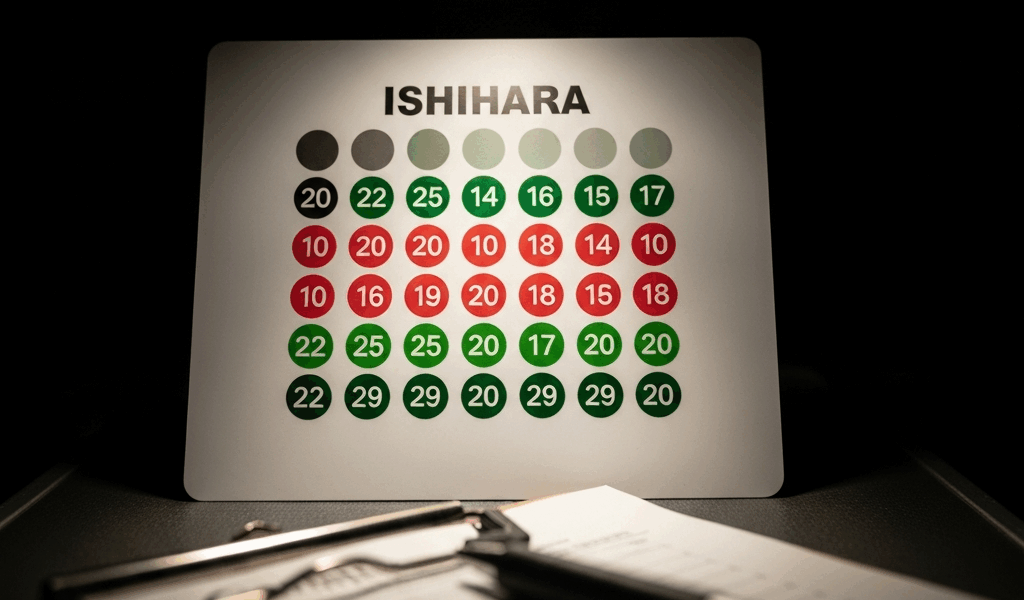
The Ishihara pseudoisochromatic plate test is the initial screening — 38 colored dot plates where you identify hidden numbers. Straightforward, except the military version is stricter than what civilians take. The civilian Ishihara uses 24 plates. Military examiners often deploy the full 38-plate protocol and demand more correct responses. One missed plate on a civilian exam might trigger “refer for further testing.” That same miss on military Ishihara? Disqualification.
Then there’s the Farnsworth Lantern Test, or FALANT. This one actually simulates operational demands. You’re looking through a viewing device at small colored lights—red, green, white, yellow—appearing randomly. Rapid identification required. This test catches something the Ishihara plates miss: functional color discrimination when you’re tired, stressed, or scanning through less-than-ideal lighting. That’s closer to what you’d encounter on an actual instrument panel.
The Functional Color Vision Assessment, or FCVA, is the newest option. It’s essentially a sophisticated computer-based test presenting color discrimination challenges with time pressure and variable lighting. Some branches are adopting this because it correlates better with actual pilot performance than older methods.
But what is the military actually screening for? In essence, it’s red-green color vision deficiency — protanopia (missing red receptors) or deuteranopia (missing green receptors). Not blue-yellow color blindness. Not mild color preference. The military screens ruthlessly for red-green deficiency because instrument panels, warning lights, and navigation signals rely heavily on red-green contrast. But it’s much more nuanced than that.
Why Pilots Fail When They Think They’ll Pass
Probably should have opened with this section, honestly.
Your civilian eye doctor runs a basic color blindness screening—maybe the 24-plate Ishihara, maybe a quick color confusion test. You pass. You see colors fine in normal daylight. Then you arrive at MEPS or your flight surgeon, take the military version, and fail. What happened?
The military standard is substantially more sensitive than civilian standards. A mild red-green deficiency that doesn’t interfere with driving or everyday life will absolutely cause failure in military aviation screening. Your eyes might process enough red and green information for normal functioning, but not enough for the military’s operational threshold. That gap exists because military aviation operates under conditions your civilian optometrist never tests for.
Consider the F/A-18 Super Hornet’s instrument panel — color-coded switches and indicator lights throughout the cockpit. The Tactical Situation Display uses red, green, and amber symbology. During low-light combat approaches or night carrier operations, those color distinctions become critical: “engine fire” (red) versus “engine caution” (amber). Under fatigue — and pilots fly exhausted — color discrimination degrades further. Someone with mild protanopia might identify colors perfectly in an air-conditioned optometry clinic at 3 PM but struggle with identical discrimination at 3 AM after 10 hours of flight operations.
The military tests under operational stressors. The FALANT test requires rapid successive identifications — your brain can’t compensate through context or logic. Colors appear, you call them, they disappear. No time to reason through it. Many people with mild red-green deficiency pass static color tests through mental compensation but fail rapid discrimination tasks.
Weather factors in. Dust, rain, or particulate haze over deployed regions changes how light reaches your eyes. Cockpit lighting varies by aircraft and mission. A color you identify confidently in standard daylight becomes ambiguous under amber-filtered lighting in a night-vision-compatible cockpit.
The Waiver Path That Actually Works
The functional color vision assessment pathway is real, and branches do grant waivers. Approval rates vary wildly though, and most applicants don’t know to pursue it.
The FCVA was developed specifically to address over-exclusion from Ishihara and lantern tests. The theory is sound: if someone demonstrates functional color discrimination under operational conditions, they shouldn’t face disqualification from a static test. The Navy and Air Force both recognize FCVA results as legitimate alternatives. Approvals sit around 15-25% for people failing initial lantern or Ishihara assessment. Not guaranteed, but it exists.
Here’s the actual process. First, you need documentation of your color vision status. Request a comprehensive color vision evaluation from a civilian ophthalmologist or optometrist — not a general practitioner, an actual eye specialist. Specifically request Ishihara plates, Farnsworth D-15 testing, and ideally the FCVA or similar functional assessment if available. The goal is documenting not just whether you have color vision deficiency, but what type and severity. Some deficiencies are more functionally limiting than others. That distinction matters.
Next, request waiver consideration through your branch’s medical authority. The Air Force routes this through the Air Force Medical Qualification Review Board. The Navy uses Navy Medicine Waiver Authority. This isn’t a casual request — it requires your testing results, a statement from your flight surgeon about operational implications, and sometimes aviation medical literature supporting your specific case. The Army’s pathways are less formal but also less frequently pursued.
Timing is crucial. Submit documentation early, before your initial military color vision test if possible. Once you formally fail and face disqualification, the waiver process becomes an appeal rather than pre-screening, and the tone shifts from “can this applicant function” to “can we overturn a disqualification.” The first scenario is more favorable.
Be realistic: waivers aren’t granted universally. The military protects operational safety, and conservative standards are justified. Your case strengthens if you demonstrate mild color vision deficiency, functional testing shows reliable discrimination of critical colors, and your target airframe doesn’t depend heavily on color discrimination for safety-critical tasks. Some aircraft are more color-dependent than others.
How to Prepare If You’re On the Edge
If you suspect mild color vision deficiency, don’t wait for military testing to discover it.
Schedule a comprehensive civilian eye exam now — not the quick screening at your annual physical. Find an ophthalmologist and specifically request color vision testing. Ask for Ishihara plates and the Farnsworth test. This baseline is invaluable. You’ll know before MEPS whether there’s actually a problem, and if there is, you have time to pursue the waiver pathway proactively instead of reactively.
Familiarize yourself with actual Ishihara test materials. You can’t game the test — if you have color vision deficiency, you have it — but you can become comfortable with the format and conditions. Some deficiencies cause consistent misidentification of specific color combinations. Knowing your personal pattern helps you understand what you’re dealing with.
Request military-standard color vision testing through your flight surgeon or recruiting office before your official MEPS evaluation if possible. Some flight surgeons conduct preliminary assessments. Failing at that stage means you know where you stand and can pursue the waiver pathway rather than getting blindsided at MEPS.
What not to do: don’t try memorizing Ishihara plates to fool the test. Examiners spot this, and it’s disqualifying dishonesty that ruins your entire application. Don’t avoid testing hoping it disappears. Don’t claim you lack color vision deficiency if you have it — the military’s medical screening exists for legitimate safety reasons.
Non-Pilot Roles If Disqualified
Color vision disqualification for pilot slots doesn’t mean aviation is closed to you.
Weapons Systems Officers (WSOs) in the Air Force don’t have pilot-level color vision requirements. Neither do Combat Systems Officers (CSOs) in the Navy. These are rated positions — you wear the same flight suit, get the same prestige, and have genuine command authority. The job demands differ. You’re managing systems and making tactical decisions rather than flying the aircraft, which changes what visual acuity and color discrimination mean operationally.
Naval Flight Officers (NFOs) have more relaxed color vision standards than pilots. Loadmasters in the Air Force don’t require pilot-level color vision qualification. Non-rated aviation positions exist too: flight engineers, sensor operators, and maintainers. They’re not identical careers to being a pilot, but they’re legitimate pathways in aviation.
I’m apparently the type who believes in being straight about this — if you wanted to be a pilot, these aren’t the same thing. But they’re real careers with real advancement opportunities, and color vision disqualification doesn’t close them entirely. The military still needs people in those roles.
The military color vision test failure rate exists because the military’s standard is purposefully strict. That strictness isn’t a mistake — it’s intentional. Understanding what you’re actually failing, why the standard exists, and what your realistic options are changes whether this disqualification is final or simply a detour.


Leave a Reply